
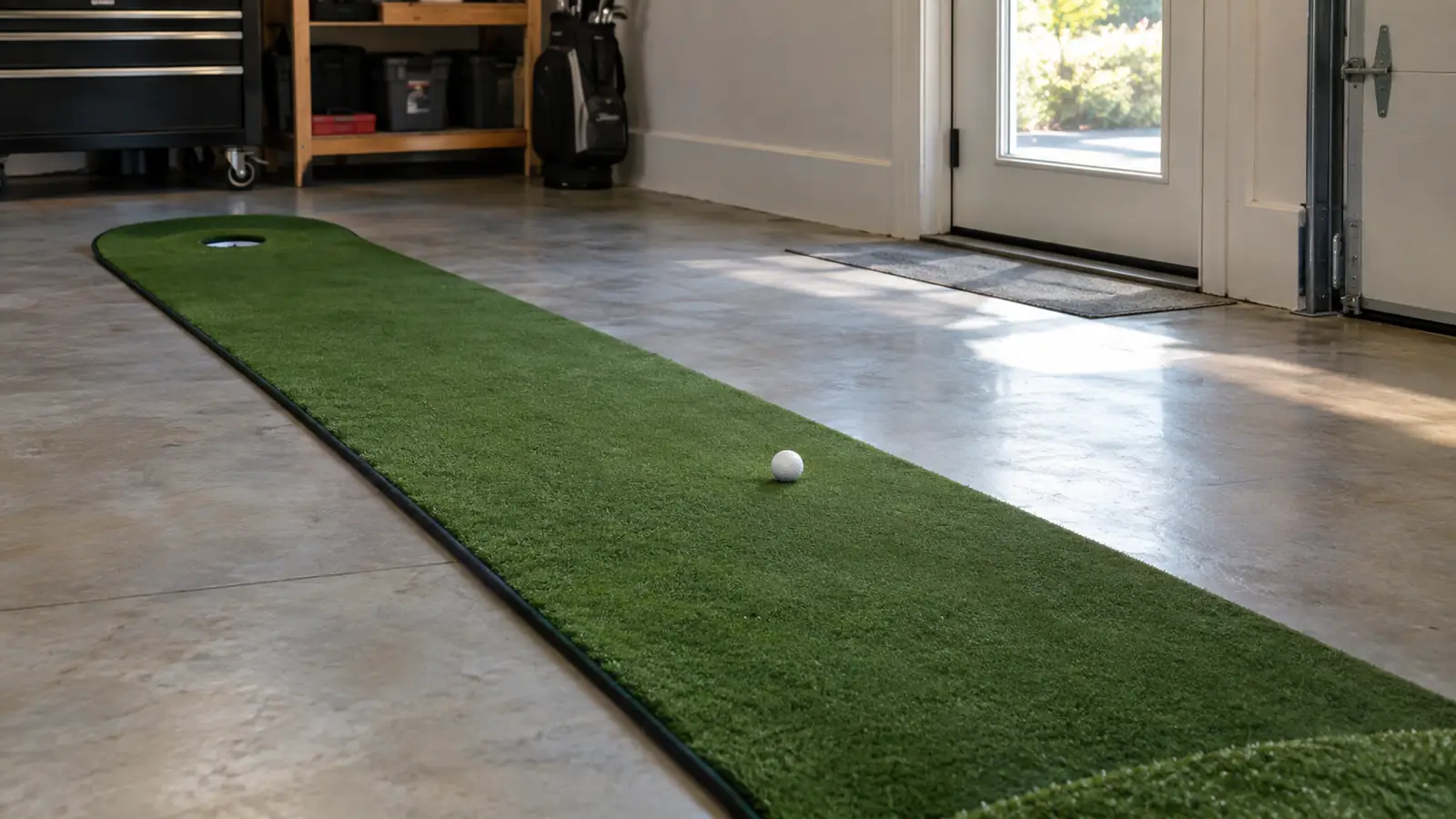
I've been playing golf badly enough for long enough to know that most practice aids end up in a closet by February. So when I tell you the PUTT-A-BOUT Par Three Putting Green has been sitting on my garage floor since June, not folded up in a corner, that means something. I'm Gene, I'm 58, I play to about a 14 handicap, and I walk nine holes twice a week at my local public course in Monmouth County, New Jersey. My putting has always been the weakest part of my game, and this green has become the center of a small nightly ritual that has actually changed how I putt.
This is the honest version. The one that tells you what the product photos don't, what the Amazon reviews gloss over, and what I wish someone had told me before I bought it. Because there are things about the PUTT-A-BOUT that flat-out annoy me, and there are other things about it that have made me a better putter at 58 than I was at 40. Both of those statements are true, and you deserve to hear both before you spend your money.
The Quick Verdict
The PUTT-A-BOUT Par Three is the rare practice aid that earns its floor space. It will not fix your stroke by itself, but if you actually use it daily, it will make you a more confident putter inside ten feet. Just know the surface is not a true green, and the narrow width will not help you read breaks.
Amazon Check Today's Price →The putting green that actually stays out in my garage
After six months of daily use, the PUTT-A-BOUT Par Three is still the first thing I see when I open the garage door. If you're serious about shaving strokes, this is the practice tool that delivers.
Amazon Check Today's Price on Amazon →How I've Used It
I'll be straight with you: I did not buy this green with a grand plan. My wife Carol got tired of me complaining about three-putting, and one Saturday she said, 'Gene, either do something about it or stop talking about it.' So I did what any practical guy in his late 50s does. I looked at the options, read a pile of reviews, and settled on the PUTT-A-BOUT because it was big enough to feel real and small enough to fit against the wall of a two-car garage.
That was six months ago. The green has been on the floor almost every day since. My routine is simple: after dinner, I take ten minutes to hit putts from three, six, and nine feet. Sometimes I set up a little gate with two tees to work on starting line. Sometimes I just roll putts and watch the ball drop. The dog, Murphy, a yellow Lab, has learned to give the garage a wide berth when he hears the putter clicking, because he once got bonked by a stray ball and he has not forgotten.
This was not my first attempt at an indoor putting setup. Two winters ago I bought a cheap carpet mat that curled at the edges and rolled so fast the ball never stopped, and it ended up in the back of a closet by February. That failure taught me what I actually needed: something heavy enough to lie flat on concrete, long enough to feel like a real putt, and narrow enough to lean against the wall when Carol wants the garage for something. That old mat taught me that cheap and thin are the same word when it comes to putting surfaces. The PUTT-A-BOUT is the first mat that has met all three conditions.
The important thing is that this is not a once-a-week thing. The PUTT-A-BOUT lives on the floor, so I use it. That may sound like a small thing, but it is the whole ballgame with practice aids. The best training tool in the world is worthless if it lives in a closet. This one stays out, it takes up a defined space, and it has become part of the evening routine. That alone has been worth what I paid, and I did not pay much.

What Nobody Tells You About the Surface
Here is the honest truth that the marketing photos will not show you: the putting surface on the PUTT-A-BOUT is not a true green. It is a synthetic turf that rolls a bit faster than a typical municipal course green in the middle of summer, and it rolls a bit slower than a country club green on a dry day. It is perfectly consistent, which is both the best and worst thing about it.
The consistency is what makes it useful. Every putt you hit on this green rolls exactly the same, every time, regardless of the time of day or the weather. That means you can actually work on your stroke mechanics without variables getting in the way. When I miss a putt on the PUTT-A-BOUT, I know it was my stroke, not a bump in the surface or a spike mark. That is a powerful thing for a mid-handicapper who tends to blame everything except his own technique.
But here is what nobody tells you: because the surface is so consistent, it will not teach you to read greens. Real greens have grain, subtle slopes, imperfections, and speed changes depending on the time of day. The PUTT-A-BOUT is flat, and it is flat in a way that no real green ever is. So if you spend all your practice time on this thing and none on real greens, you will get very good at hitting putts on a perfectly flat, perfectly consistent surface, and that skill only transfers so far.
The other thing nobody tells you is that the surface needs to be flat to work. The green is basically a rubber-backed turf mat, and if you lay it on an uneven garage floor, you will get a bump or a dip that turns a straight putt into a mystery. I have mine on a section of floor that is reasonably level, and it is fine. I learned this the hard way in my second week. I kept missing a six-footer to the right, night after night, and I was ready to blame the green. Then I got down at eye level and saw that the floor under the far corner had a low spot the size of a dinner plate. The mat was fine. The floor was lying to me. I slid a folded piece of cardboard under that corner, and the same putt started rolling dead straight. That is the kind of detail you only catch after a week of nightly practice, and it is the kind of thing no product photo will ever show you. But if you are planning to put this on a carpeted room with a soft pad underneath, or on a concrete floor with a noticeable slope, you need to sort that out first or you will be blaming the green for putts that are actually rolling over a hidden rise.
The PUTT-A-BOUT will not teach you to read greens. What it will do is make your stroke so repeatable that you stop three-putting from inside ten feet, and for a 14-handicap, that is the whole game.
The Real Improvement: Inside Ten Feet
Let me tell you what actually changed. Before I got the PUTT-A-BOUT, my biggest problem was not the long putts. It was the ones inside ten feet. I would leave them short, or I would pull them, or I would get so tense over a three-footer that I would jab at it. The yips are real, and at 58 they were starting to visit more often.
After about three weeks of nightly practice on the PUTT-A-BOUT, something shifted. I stopped being afraid of the short ones. The repetition of hitting a hundred putts a week from three, four, and five feet built a kind of muscle memory that I had never developed before, because I had never practiced that much in my life. My stroke got shorter, my tempo got steadier, and I stopped flinching at impact.
The scores reflect it. My handicap has not dropped dramatically, because my ball striking is still mediocre and my course management still leaves something to be desired. But my putts per round have gone from around 34 down to around 31, and that is almost entirely from making more of the short ones. On a Saturday round with my usual group, I am no longer the guy who gives away strokes on the green. The round that convinced me was in early September. I made three par saves from inside five feet on the front nine, and one of my buddies, who has been teasing me about my putting for years, finally asked what I had changed. When I told him it was a nine-foot mat in my garage, he laughed. Then I finished the round with 29 putts, the lowest number I have posted since I started keeping score seriously, and he stopped laughing. Nobody in our group practices short putts at home. That is why they keep three-putting, and that is why I stopped. That is a real, measurable change, and I attribute most of it to the simple act of practicing every day on a green that is always there.
There is also a confidence effect that is hard to quantify but very real. When you have made a thousand three-foot putts in your garage, a three-foot putt on the course stops feeling like a crisis. You have done this exact thing before, thousands of times, and your body knows it even when your brain is nervous. That confidence is worth more than any piece of equipment in your bag.
The Frustrations: Size, Roll, and the Cup
Now the honest complaints. First, the green is narrow. At three feet wide, it is not much wider than a putter is long, and it does not give you any room to practice putts with a meaningful break. You can set up a slight angle if you putt across the width, but it is not the same as practicing a real breaking putt on a real green. If your main weakness is reading breaks, this green will not help you much.
Second, the surface is what it is. It is not a high-end indoor putting turf like the fancy ones that cost five times as much. It has a slight texture that you can feel, and the ball rolls with a tiny bit of noise that you do not get on real grass. None of that matters for the purpose of grooving a stroke, but if you are expecting a true green experience, you will be disappointed.
Third, the ball return is a mixed bag. The green has a slight incline at the far end that is supposed to send missed putts back to you, and it works, but it also means the green is not perfectly flat. The slight tilt at the end can subtly influence putts that are rolling past the hole, which is something you have to account for when you are practicing longer putts. It is not a dealbreaker, but it is a quirk. Here is what it does in practice. A putt from inside six feet is slowing down by the time it reaches the far end, so the incline barely touches it. But a firm nine-footer that rolls past the hole hits that ramp with some speed, and it kicks sideways when it climbs. I spent a full week wondering why my long misses kept drifting one way before I set a ball on the ramp and watched it roll back on its own. Now I do most of my distance work from the middle of the mat, and I treat anything that touches the ramp as a miss, because it is not a true roll anymore by the time it gets there.
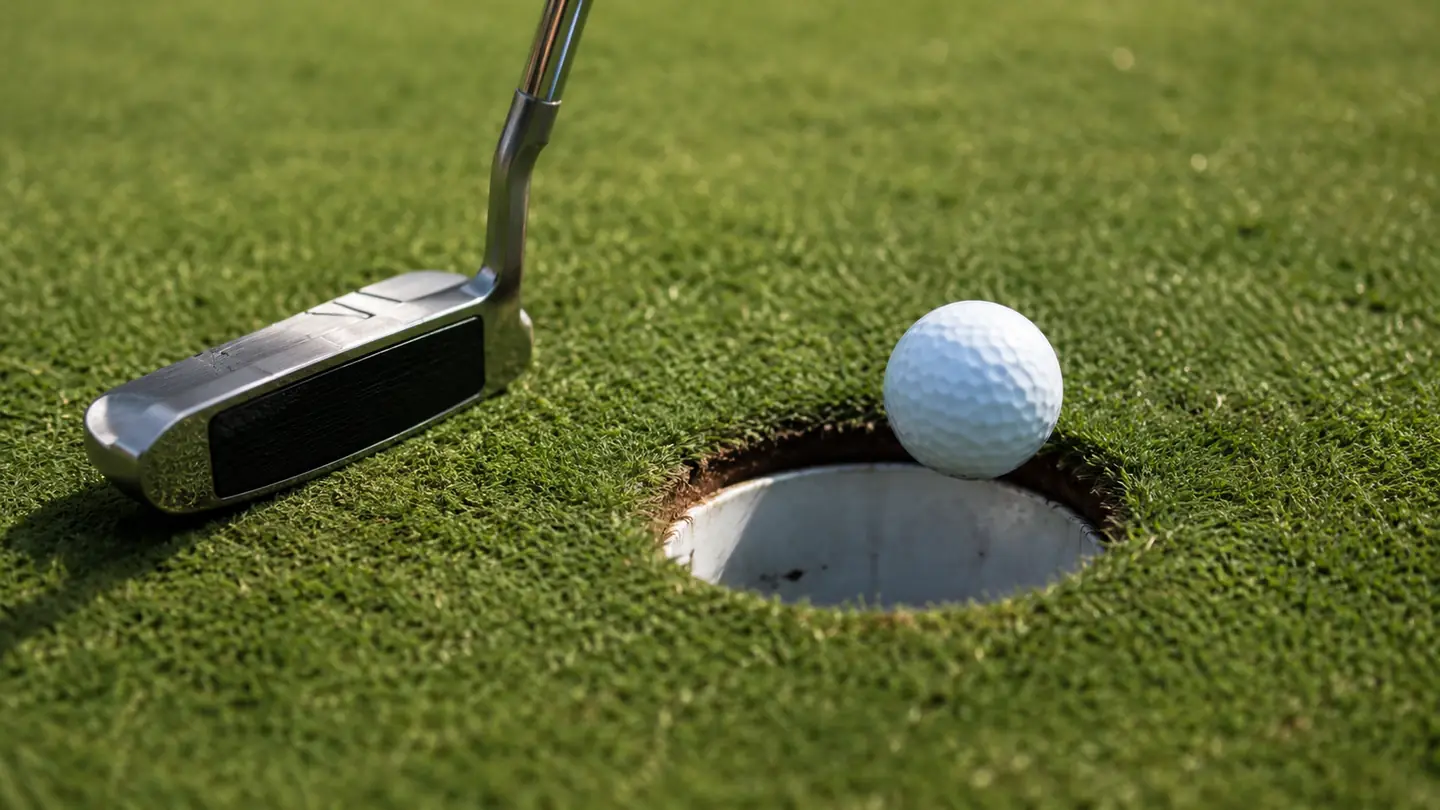
Fourth, the cup is a standard plastic cup insert that sits in a precut hole. It works fine, but the ball does not always drop cleanly. Sometimes it rattles around the edge and sits half in, half out, which can be frustrating when you are trying to track your make percentage. I have learned to count a ball as 'in' only when it is fully in the cup, which is stricter than the course rules, and that has probably helped my putting more than it has hurt it.
Who This Is For
The PUTT-A-BOUT Par Three is for the golfer who knows exactly what his problem is: he is losing strokes inside ten feet, and he needs a way to practice that stroke at home, every day, without driving anywhere. It is for the weekend golfer who does not have time for the range but has ten minutes after dinner. It is for the guy like me, the mid-handicapper in his 50s or 60s who is not going to rebuild his swing but can absolutely learn to make the short ones.
It is also for the golfer who needs a practice aid that stays out and visible. If you are the type of person who puts things away and forgets about them, the size and weight of this green (it is not heavy, but it is not something you fold up and stash on a shelf) work in your favor. It is a constant reminder to practice, and for me, that reminder has been worth the floor space it takes up.
Who Should Skip It
If your putting problem is speed control on long putts, or if you struggle to read breaks, this green is not the answer. It is flat, it is narrow, and it rolls at a consistent speed that will not teach you the delicate touch needed for 30-foot putts with a double break. You would be better served by practicing on a real putting green, or by buying a larger, more expensive mat that gives you more room.
If you have a perfectly flat, perfectly consistent indoor space, you might be fine. But if you are planning to lay this on a carpet with a thick pad, or on a floor that is noticeably uneven, you will be fighting the surface rather than practicing your stroke. And if you are the type of golfer who buys practice aids and never uses them, save your money. This green only works if you actually use it.
What I Liked
- Stays flat on a reasonably level floor and holds its position well
- Consistent roll that is ideal for grooving a repeatable stroke
- Compact enough to live permanently in a garage or spare room
- Sturdy construction that shows no wear after six months of daily use
- The slight incline at the far end returns missed putts, so you never stop to chase balls
- A fraction of the cost of a bigger, fancier mat, and it does the core job just as well
Where It Falls Short
- Narrow three-foot width leaves no room for practicing breaking putts
- Surface is not a true green and will not teach you to read real-world grain or slopes
- Needs a flat floor; any dip or rise underneath turns straight putts into guesswork
- The cup does not always catch the ball cleanly, which can be annoying when tracking makes
- Will not help with lag putting or speed control from distance
The honest bottom line: it earned its spot in my garage
Six months in, the PUTT-A-BOUT is still the first thing I see every morning. If you want to stop three-putting from inside ten feet, this is the most practical way I have found to do it.
Amazon Check Today's Price on Amazon →