

I have spent four months walking the same nine holes twice a week and playing my Saturday round with the same three guys, and for every shot I care about, the Callaway 300 Pro has been in my hand. That is not a small thing for a 58 year old who plays to about a 14 handicap. My eyes are not what they were when I ran my own HVAC crew, and I used to pace off yardages and guess at the rest. I still guess sometimes, but a lot less often than I used to.
This is a long term review, which means I am not going to hand you a verdict based on one sunny afternoon at the range. I have used this rangefinder through a full stretch of New Jersey golf: wet mornings, windy Saturdays, league nights with the slope switch off, and a fair number of range sessions ten minutes from home. The only member of the household who is not impressed is Murphy, our yellow Lab, and he is not impressed by anything that is not food. The rangefinder has survived all of it, and it has taught me where it falls short. I am going to tell you about both sides.
The Quick Verdict
The Callaway 300 Pro is the rangefinder I reach for every round because it locks on fast, reads clearly, and has a slope switch that actually gets used. It will not fix a bad swing, but it will take the guesswork out of every number you face.
Amazon Check Today's Price →The rangefinder I have trusted for four months of weekend rounds
The Callaway 300 Pro has been clipped to my push cart through rain, fog, and a full season of Saturday foursomes. It locks onto the flag fast and the slope numbers are easy to trust. Check today's price on Amazon and see if it belongs in your bag.
Amazon Check Today's Price on Amazon →How I've Used It
I bought this rangefinder for a simple job: give me the number to the flag without making me think. My home course is a public layout in Monmouth County, and I walk it with a push cart. Twice a week I play nine holes after lunch, and on Saturdays I join my usual foursome for eighteen. The rangefinder lives clipped to the cart handle in its case, and that handle has taken a lot of jostling, two or three light rain showers, and one drop onto the cart path that I am still not proud of. I wanted a tool that would not make me think, because thinking too long over a shot is how I turn a routine par into a double bogey.
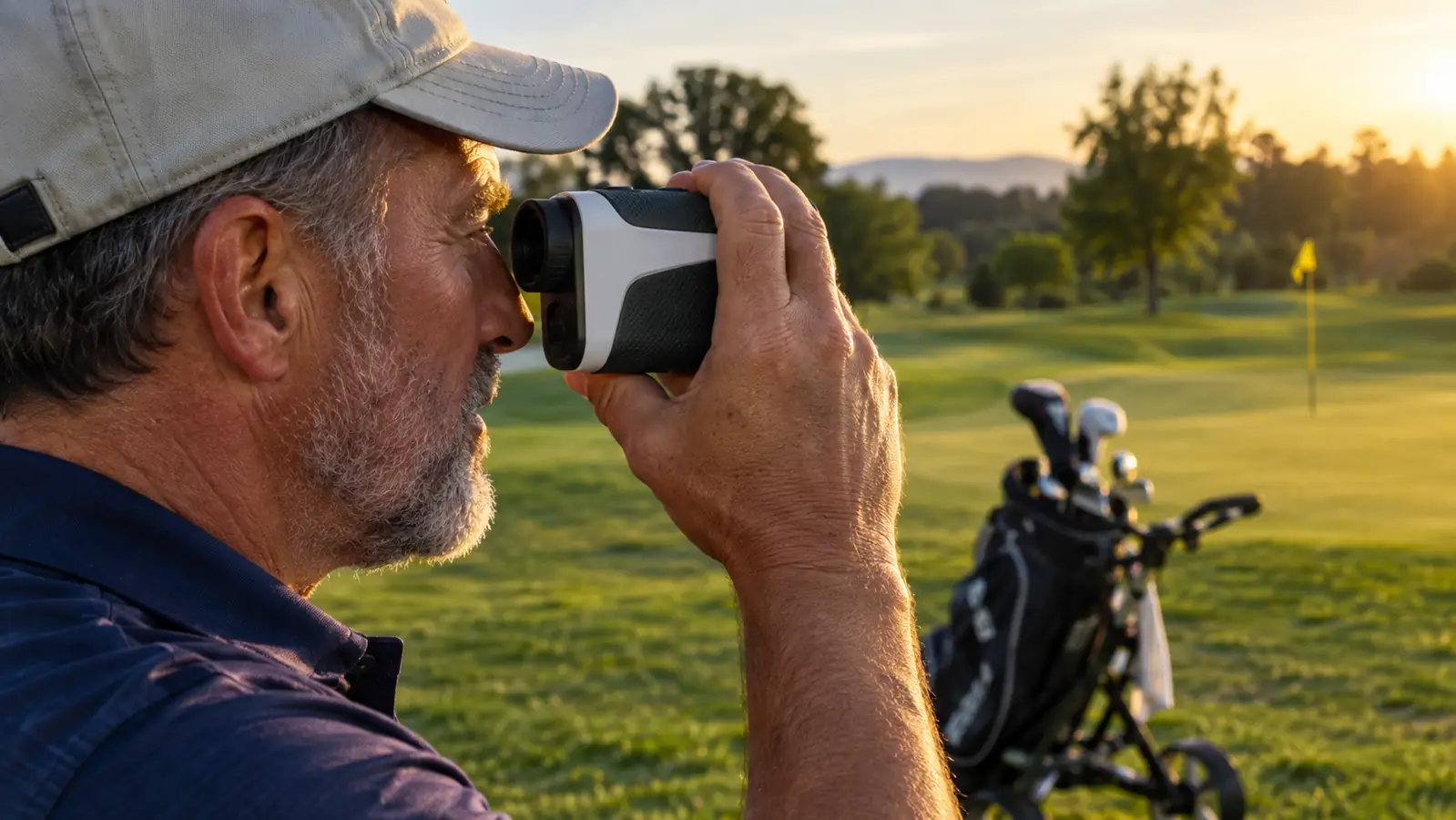
I use it on nearly every approach shot and on most tee shots where the fairway bends or the pin is tucked behind a bunker. I use the slope reading on the range too, because the landing areas sit above the mats and a flat yardage lies to you there. The routine is the same every time: raise it, find the flag through the 6x view, wait for the short vibration that says I am locked, write down the number, and trust it.
One thing I have learned in four months is that a rangefinder only helps if you actually use it, and that is where this one wins. It stays on the cart handle, not in the trunk, because it is fast enough that grabbing it does not slow down the group. My buddies have noticed. Two of them have asked to borrow it on the tee, and one of them bought his own a few weeks later.
The Slope Switch Is the Feature I Use Most
The reason I picked the 300 Pro over cheaper options is the external slope switch. Some rangefinders make you dig through a menu to turn slope off. This one has a switch on the outside, so I can flip it on for practice rounds and flip it off before a league night without hunting for settings. That is a small thing until you are standing on the first tee with people waiting behind you.
On my course, slope matters more than I expected. Several holes sit with greens fifteen or twenty feet above the fairway, and I used to come up short on those every single time. The slope number tells me to grab one more club, and the adjustment has been consistent enough that I now trust it without second guessing. When the switch is off, the unit gives plain yardage with no adjustment, which is what you want when the round is being played under strict rules.
The vibration lock is the other feature I did not expect to rely on. When the unit locks onto the flag, it gives a short buzz. That buzz matters because it tells me I am aiming at the pin and not the trees behind the green. I have been fooled by background objects with cheaper optics, and the vibration has saved me more times than I can count. It is the difference between a rangefinder I trust and a toy I would have stopped carrying by August.
How the Numbers Held Up Over Months of Rounds
Over the past months I have checked the Callaway 300 Pro against course markers, sprinkler heads, and the yardage app on my phone. The numbers agree almost every time, and when they disagree it is by a yard or two, which is nothing on a golf course. I have learned to trust it on blind shots too, the ones where you cannot see the bottom of the flag and you have to trust the number in your head. The slope readings have been just as consistent, and I have stopped second guessing them entirely.
Battery life has been the biggest surprise. I put fresh batteries in when I started and I have not changed them since, through two or three rounds a week plus range sessions. I keep a spare set in the bag anyway, because that is the kind of habit twenty years of trades work teaches you, but I have not needed them. The battery compartment is solid too, with no signs of loosening after all the jostling it has taken. If you play as often as I do, you will probably forget the last time you changed them too.
Rain has not bothered it either. I got caught in a steady shower on the back nine one Saturday, and the unit kept working through it. I dried it with a towel when I got home and it has been fine since. I am not going to tell you it is waterproof, because I do not know that for certain, but it has survived everything a New Jersey season has thrown at it so far.
I have also used it on the practice green and the chipping area, mostly to see whether knowing the exact number changes my decisions. It does. When I know the distance to a front pin, I stop trying to force a perfect shot and start playing the percentage. That is a small mental shift, but it has saved me strokes on the days when my swing is not cooperating.
I put fresh batteries in four months ago and have not changed them since, through two or three rounds a week plus range sessions. That is the kind of boring proof that actually matters.
What I'd Change After All These Rounds
It is not a perfect device, and I would be lying if I said otherwise. The case that comes with it is basic. It does the job, but I replaced the clip with a sturdier one because the original felt thin against the cart handle. That is a small fix and an easy one, but it is worth knowing before you buy.
The display is clear, but in very bright sun I sometimes cup my hand around the eyepiece to read the numbers. It is not a deal breaker, and I have used rangefinders that were far worse, but it is the kind of thing you notice after a few months of regular use. If you play most of your golf at noon in July, you will notice it too.
The other thing I will mention is that it does not have a built in magnet mount. Some of the newer rangefinders stick right to the cart rail, which is genuinely convenient. I have gotten used to clipping mine to the handle, but if a magnetic mount is on your list, this model does not have one, and you should know that before you order.
The only adjustment I made to the unit itself was setting the eyepiece focus for my eyes, which I did one evening at the putting setup in my garage. Once it was set, I have never had to touch it again. That tells me more about the build quality than any spec sheet could.
The Other Rangefinders I Considered
Before I settled on the Callaway 300 Pro, I looked hard at the Bushnell Phantom 3 and a couple of budget models whose names I do not remember well enough to repeat. The budget ones were tempting, but the ones I tried felt slow to lock and their displays were harder to read in the same bright sun I complain about above. I gave one of them a full round before I made up my mind, because a rangefinder is the kind of thing you cannot judge from the counter. Saving money only helps if the tool does its job, and neither of those did it as well.
The Bushnell is a solid unit, and I have played with a buddy who owns one. The difference for me came down to the slope switch and the vibration lock. The Callaway gives me both in a package that feels natural in my hand. There is a full head to head comparison of the two elsewhere on this site if you want the details, but the short version is that I kept the Callaway in my bag.
If I were buying again today, I would make the same choice. The 300 Pro is not the newest rangefinder on the shelf, and it does not have every bell and whistle, but it does the things that matter on every single round. I would rather have a tool that is boring and reliable than one that is impressive in the store and finicky on the course.
What I Liked
- External slope switch flips off in two seconds for league rounds
- Vibration lock confirms when you are on the flag, not the trees
- Battery life held up through months of weekly rounds
- Clear, easy to read yardages in most conditions
- Survived rain, heat, and a drop onto the cart path
Where It Falls Short
- No magnetic mount for cart rails
- Included case and clip feel basic
- Bright sun can wash out the display at certain angles
Who This Is For
This rangefinder is for the golfer who walks, the way I do, and wants a number fast without fiddling with menus. It is for the weekend player who plays one course all season and keeps coming up short on the uphill holes. It is for the league golfer who needs a slope switch they can flip off in two seconds when the rules demand it. It is also for the player who is tired of asking their playing partners what they hit, because that habit is how you end up hitting the wrong club more often than you admit. If any of that sounds like you, this is a rangefinder you will actually use, not one that sits in the trunk.
It is also for golfers over 40 whose eyes are not what they used to be. I do not mean that as a dig at anyone. I mean that the vibration lock and the clear numbers do the work that my eyes used to do for me. That is the real value of a good rangefinder as you get older, and it is the reason mine stays clipped to the cart instead of living in a drawer.
Who Should Skip It
Skip it if you want a magnetic mount, because this model does not have one and that is not going to change. Skip it if you only play a few times a year and are happy pacing off yardages, because a rangefinder is a tool, not a score fixer. And if you are shopping purely on price, there are cheaper units that will give you a number, though you may trade away the vibration lock and the easy slope switch to get there.
I would also say skip it if you expect a rangefinder to lower your scores by itself. It will not. It will tell you the truth about the distance, and then you still have to hit the shot. That is the part no tool can do for you, and any review that promises otherwise is not being honest with you.
Stop guessing your yardage and start trusting the number
After months of rounds, the Callaway 300 Pro is still the first thing I clip to my cart. It is fast, honest, and easy to use, and the slope switch earns its place every round. Check today's price on Amazon and see if it earns a spot in your bag.
Amazon Check Today's Price on Amazon →