
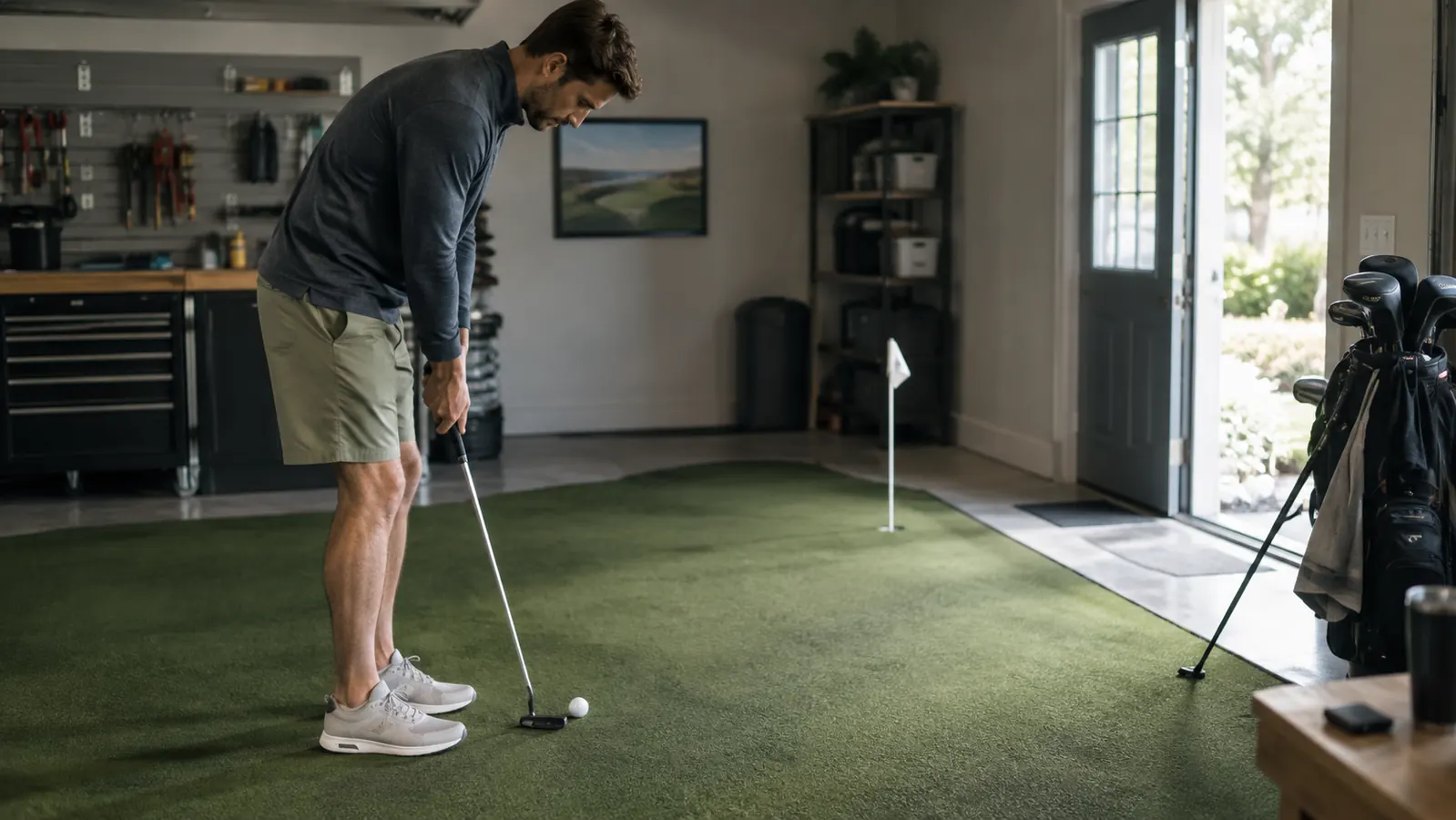
I walked off the 18th green at my home course last September with a 91 on the card. Not terrible for a 14 handicap. But I counted five three-putts in that round, and five three-putts is the difference between a 91 and an 86. I have been playing this game for thirty years, and the part that keeps costing me strokes is the part I never practiced. So last winter I cleared a corner of the garage, unrolled a PUTT-A-BOUT Par Three Golf Putting Green, and started treating putting like a skill instead of something I hoped would show up on the course.
This is not a guide that promises you will never three-putt again. I still do, every couple of rounds, and I will tell you exactly when. What I can tell you is that five months of regular work on this 3-foot by 9-foot green changed the way I practice, and it changed the way I stand over a five-footer on the course. If you are tired of watching short putts slide by and tapping in for bogey, here is the routine that worked for me, step by step.
Stop giving away strokes from six feet and in
The PUTT-A-BOUT Par Three gives you a real practice surface without leaving the house. Check today's price on Amazon and see why 24,000-plus golfers practice on this exact green.
Amazon Check Today's Price on Amazon →Step 1: Set up the green so it lies perfectly flat
Before I talk about stroke mechanics, I need to talk about the floor. The PUTT-A-BOUT Par Three is a molded plastic surface, and it will follow whatever is underneath it. I first laid mine on the garage floor without checking, and one corner sat over a low spot. The result was a putt that broke left near the cup no matter how I hit it, and I spent a week thinking I had developed a nasty push. I had not. My floor was crooked.
Fix this before you practice anything. Use a level, put it in the middle of the green, and shim the low spots with thin pieces of cardboard or rubber matting until the bubble sits centered in both directions. It took me about twenty minutes. The corner near the garage door was the problem on mine. The concrete had settled there years ago, and no amount of hoping was going to flatten it. I slid a folded piece of rubber matting under that corner, checked the level again, and the next putt rolled dead straight. If you plan to roll the green up after each session, mark the floor with tape so you put it back in the same spot every time. A flat surface is the entire foundation of the drill I am about to give you.
One more setup note. The PUTT-A-BOUT comes with two holes and two balls, which I will talk about later. Give the green a few feet of clearance at the far end so a missed putt does not slam into a shelf or a wall and bounce back at you. I learned this the hard way when a putt bounced off the tool bench and rolled under the lawnmower, which cost me ten minutes of digging. You want the ball to roll out naturally, because the roll-out is part of what you are reading.
Step 2: Build a repeatable setup and stroke from three feet
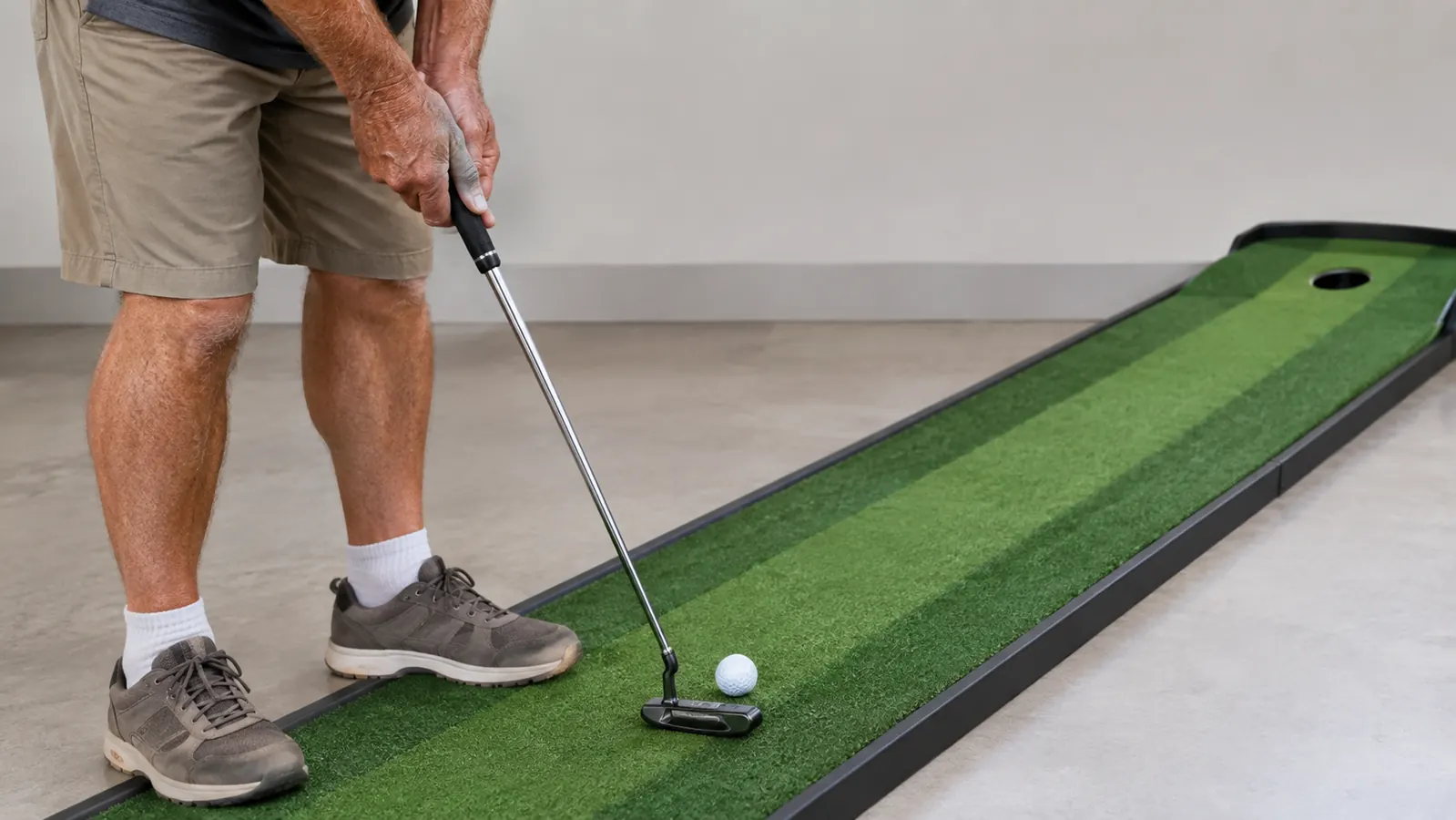
Here is the drill that fixed my short putting. Place a ball three feet from one of the holes, dead straight. Take your normal setup, make a stroke, and do not watch the ball. Keep your head down and your ears open. You should hear the ball drop. If you do not hear it drop, you missed, and you missed because your stroke moved, not because the green is hard to read.
The PUTT-A-BOUT is a fast surface, faster than most public course greens in my area, which makes it a good teacher. When the surface is quick, a small mis-hit gets exaggerated, so you learn quickly when your putter face is open or closed. I practiced this three-footer until I could make twenty in a row without thinking about mechanics. The first night I tried, I topped out at eleven before I pulled one left. It took eleven days of short sessions before I ran the full twenty, and I remember the exact putt that made it. Then I moved back to six feet, then to the far hole at nine feet.
A note on the stroke itself. I am not here to rebuild your putting technique. I am a 14 handicap, not a teaching pro. What I will say is that the repetition on a flat, fast surface gave me a consistent tempo, and consistency of tempo is what carries over when you stand over a three-footer on the 16th hole with the match on the line. Your body learns the pace of a solid putt, and that pace is the same whether the ball is on the PUTT-A-BOUT or on the course.
Step 3: Use the second hole to practice speed control
The Par Three comes with two cups, which is the feature that separates it from a lot of cheaper mats. One hole sits at the far end of the green, and the other sits off to the side. Most people use the far hole for distance and ignore the side hole. That is a mistake. The side hole is the best speed-control tool on the mat.
Here is the drill. From the middle of the green, putt to the side hole with the goal of leaving the ball no more than six inches past the cup if you miss. Then putt to the far hole and do the same thing. Alternate between the two holes for ten minutes. I found that the side hole punishes a lazy stroke more than the far hole does, because you have to change your aim line slightly and that forces you to commit to the putt. The first time I tried this drill I left four straight putts short, which told me my instinct was to baby the ball. Once I started letting the putter head do the work, the distance fell into place. What you are training is distance control, not just making putts. On the course, a putt that dies at the hole is a putt you never have to tap in, and the tap-ins are where the three-putts pile up.
I will be honest with you. Speed control is the hardest thing to practice indoors because you never get a true feel for uphill and downhill. The PUTT-A-BOUT is flat, so it will not teach you to read a breaking putt. What it does teach you is the relationship between how far your shoulders turn and how far the ball rolls. That relationship is the foundation you take to the course, and the flat surface makes it easy to isolate.
Step 4: Turn practice into a game with a scoring routine
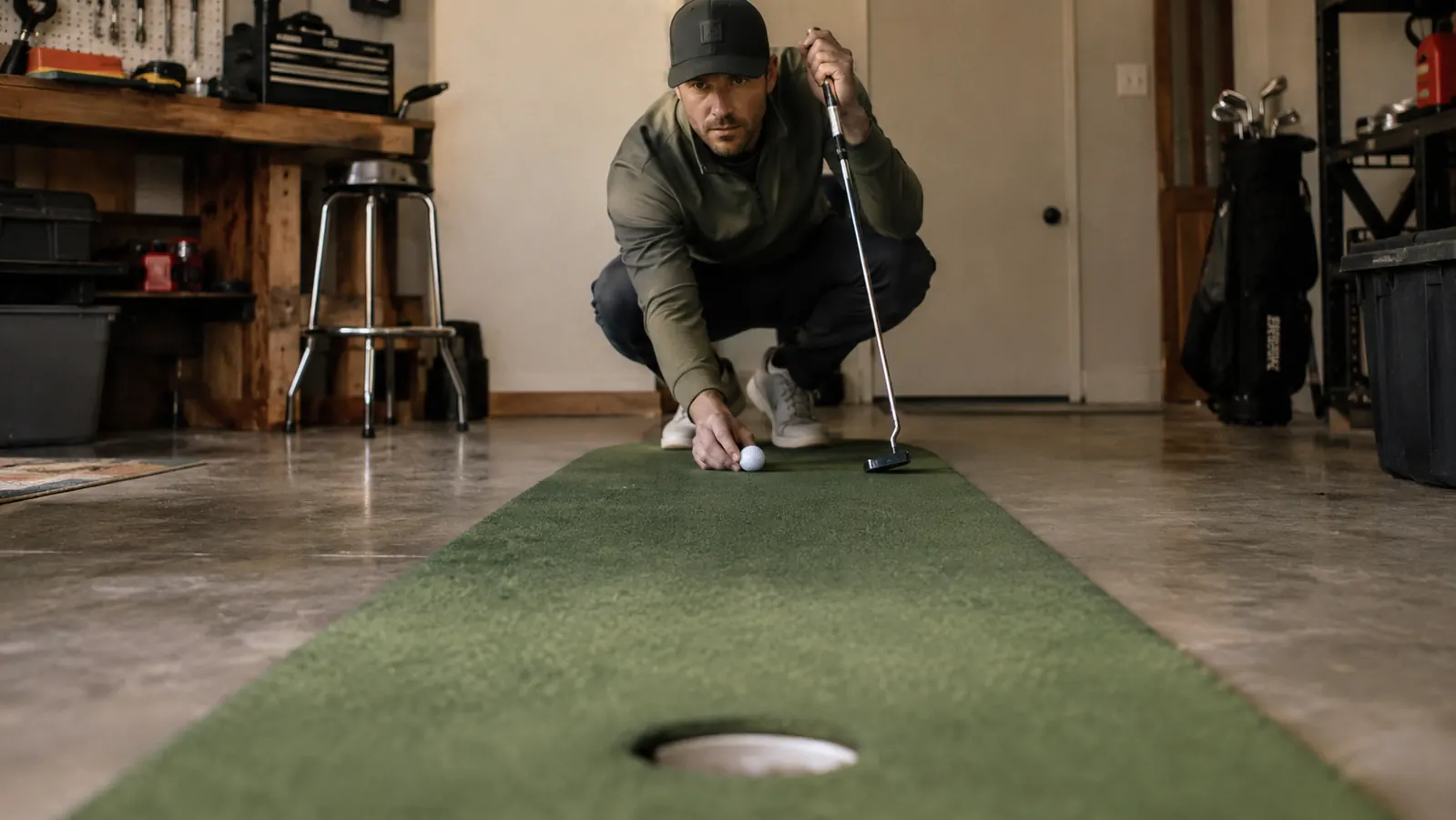
Raw repetition gets boring, and boring practice stops happening. I made it through about two weeks of straight drills before I needed something that felt like a competition. So I built a simple game that I still play three or four nights a week. I call it the 18-Putt Challenge, and it takes about fifteen minutes.
Set up nine balls around the far hole, each about five feet away, spaced like numbers on a clock. Putt all nine. Count one point for every putt that goes in, and subtract one point for every putt that stops short of the hole. Then move to the side hole and do the same thing. Best possible score is 18. My first attempt was a 9. Last month I shot a 15, and the round where I shot 15 was the same week I played a nine-hole round with zero three-putts.
The scoring matters because it gives you immediate feedback. When you are just hitting putts, you can lie to yourself about whether you are improving. When there is a number on the board, you cannot. I also keep a small notebook in the garage with my scores, and I have watched the number creep up over the months. My first week was all 9s and 10s. By the end of March I was scoring 14 or better most nights, and on April 2nd I shot a 17, missing the last putt of the night from four feet. That is the kind of proof that keeps you practicing in February when the course is closed.
Step 5: Take the routine to the course with a pre-round warmup
The garage is for building the skill. The course is for using it, and you need a bridge between the two. My bridge is a five-minute warmup on the practice green before every round. I do not hit thirty putts. I hit ten, and I hit them with the same routine I used on the PUTT-A-BOUT: a three-footer to hear the ball drop, a five-footer to feel the pace, and a long lag putt to see how the real greens are running.
What changed for me is that the warmup stopped being a formality. It used to be ten random putts while I waited for my buddies to show up. Now it is a checklist, and it mirrors what I did in the garage the night before. I start with the three-footer, then the five-footer, then a lag putt from the far edge of the practice green, and I do not step onto the first tee until I have seen the ball drop at least twice. The muscle memory from the PUTT-A-BOUT does not transfer automatically, but it transfers faster when you give it a few minutes on the real surface first.
The honest result, five months in. I still three-putt, but I three-putt about once every two rounds instead of three or four times a round. The round that convinced me was the third Saturday in March. I walked off with an 88 on the card, my best score in two years, and I had one three-putt all day. The week before I had four. Same course, same buddies, same conditions, the only thing different was the warmup. The biggest change is not the number of putts I make. It is the number of putts I leave within a foot of the hole. The tap-ins are gone because the speed is right, and when the speed is right, the score takes care of itself.
What Else Helps
The PUTT-A-BOUT is the centerpiece of my garage setup, but it is not the only thing in the corner. A putting mirror or a simple alignment rod helps you check your eye position, and a small bag of practice balls means you are not chasing one ball across the garage after every stroke. The PUTT-A-BOUT ships with two balls, which is enough to start, but I picked up a dozen practice balls at a yard sale and it made the 18-Putt Challenge flow much faster.
I also recommend a putting mat with a steeper incline if you want to practice breaking putts, because the Par Three is flat and will never give you a true sidehill read. That is not a flaw. It is a design choice that makes it perfect for the fundamentals. If you want to work on reads, you can prop one edge of the PUTT-A-BOUT up on a rolled towel to create a slight tilt. It is not as good as a real slope, but it is better than nothing, and it costs nothing to try.
I walked off with an 88 on the card, my best score in two years, and I had one three-putt all day.
Start with a flat green and a clear routine
The PUTT-A-BOUT Par Three has been in my garage since January, and it is still the first thing I reach for when I want to work on putting. Check today's price on Amazon and build the same routine for yourself.
Amazon Check Today's Price on Amazon →