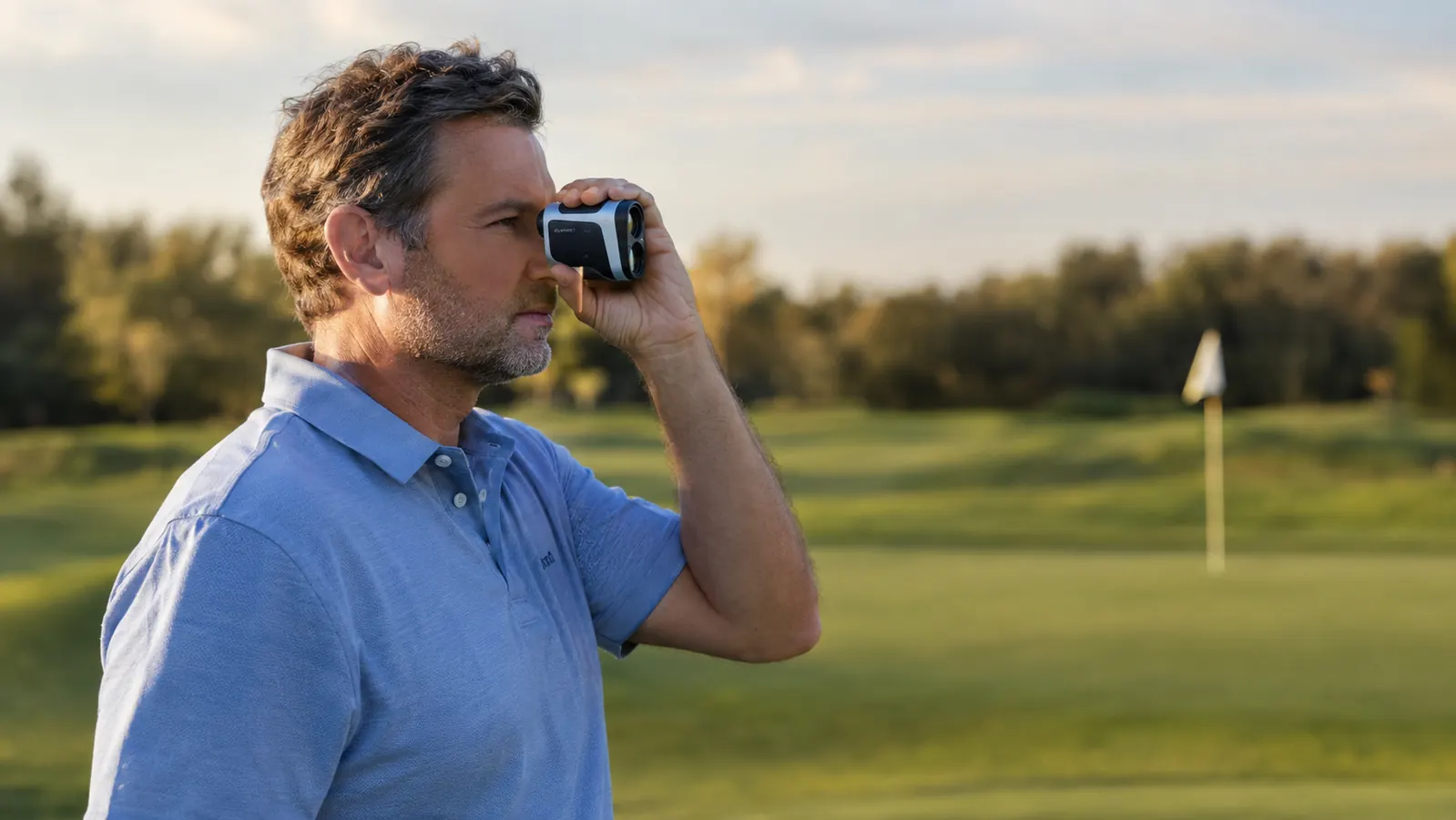
I spent most of my golf life guessing. I would stand over a shot, pick a number out of my head, and then hit a club that had nothing to do with the actual distance. Some of that was habit. A lot of it was the 14-handicap habit of trusting a feel that was never very accurate in the first place. Then a buddy in my Saturday foursome showed up with the Callaway 300 Pro, and the way he played changed enough that I started paying attention.
The Callaway 300 Pro is a laser rangefinder with an external slope switch, and it gives you a precise yardage in about two seconds. I am 58 years old, I play to about a 14, and I walk nine holes twice a week at my home course in Monmouth County, New Jersey. I am not a long hitter and I am not getting any longer, so the number in my hand matters more every year. This guide is how I use it on every hole I play, step by step, including the mistakes that still cost me strokes.
Know the Real Number Before You Pick a Club
The Callaway 300 Pro gives you the distance to the pin, the distance with slope, and the confidence to stop guessing. Check today's price on Amazon and see what it does on your home course.
Amazon Check Today's Price on Amazon →Step 1: Shoot the Flagstick From the Tee Box
The tee box is where I used to waste the most information. I would watch a buddy hit, then step up and try to remember what the scorecard said. The card tells you the total yardage, but it does not tell you where the pin is today, whether the fairway runs downhill, or how much wind is in your face.
Now I take the Callaway 300 Pro out of its pouch on the cart, aim at the flagstick, and press the button once. The numbers come back in about two seconds. I write the number down in a small notebook I keep in the pouch, and I add or subtract the slope reading if the hole asks for it. Here is a real example from my course. The fourth hole is a 341-yard par 4 with a fairway bunker on the right that eats bad drives. The scorecard says 341 and nothing else. One Tuesday morning last August, I shot the flag from the tee and got 327. I shot the bunker and got 211. I hit a driver that carried the corner and left me 112 in, which is a comfortable pitching wedge for me. Two numbers, about ten seconds of work, and the hole turned into a plan instead of a hope.
The trick is to shoot the flag, not the trees behind it. The 300 Pro has a jolt vibration that tells you when it has locked onto the target. If you feel the pulse, you are good. If you do not feel it, aim again. On a busy Saturday, that saves me from standing over the ball with a number I do not trust. This matters more as the season goes on. By September, the trees on my course are full and the light gets flat late in the day, and that is exactly when a laser can grab a branch instead of the pin. The vibration is my check on all of that.
Step 2: Use the Slope Switch the Way It Was Meant to Be Used
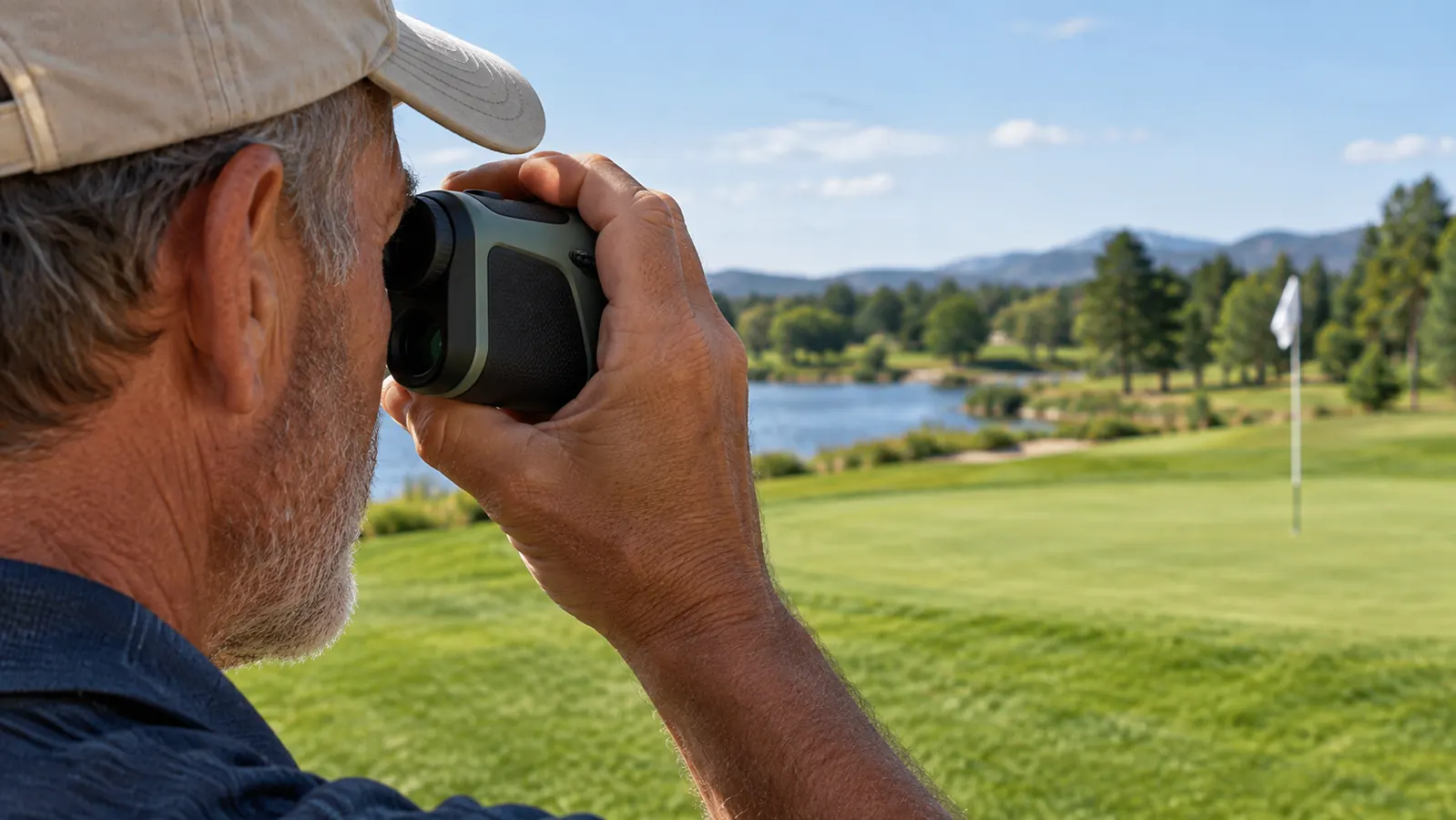
The 300 Pro has an external slope switch on the side of the unit. Flip it on and it gives you a slope-adjusted number that accounts for uphill and downhill shots. Flip it off and you get the straight-line distance, which is the legal number for tournament play.
My rule is simple. For casual rounds and practice, slope stays on. For anything that matters, like a league match or a Saturday game with money on the side, slope goes off and I use the plain number. It takes two seconds to flip, and it keeps me honest.
The slope reading on the Callaway 300 Pro is not a gimmick. On a hole that plays uphill, the difference between the straight distance and the slope distance can be a full club. On a downhill hole, it can be the difference between flying the green and landing short. I learned that the hard way on my home course, where the par 5 11th plays uphill the whole way. Last spring I played the 11th in a Saturday match against one of my regular buddies. The 11th is 451 yards on the card, but it plays longer than that. I hit a good drive and had 218 to the flag, dead into a light breeze. The straight number said 218. The slope number said 226. I did not believe it, so I hit the 5-wood I would normally hit from 218, I caught it flush, and I still came up 16 yards short, the ball rolling back down the slope. My buddy had the same shot, trusted the slope number, hit a 3-wood, and landed on the front edge. That one decision cost me the hole and the match. I have used the slope number on that hole ever since.
Step 3: Shoot Your Layup Number, Not Just the Flag
Most amateurs only shoot the flag. The Callaway 300 Pro gives you a lot more than that, and the layup number is the one that saves me the most strokes. On a long par 5, I will shoot the flag first, then shoot the corner of the fairway bunker, then shoot the 100-yard marker.
That gives me three numbers for one hole. I know how far the flag is, how far the danger is, and how far the spot I actually want to hit is. When I stand over the ball, I am aiming at a specific distance, not a general area. Here is how I play the other par 5 on my course, which bends left and plays 492 on the card. From the tee I shoot the flag and get 487. I shoot the fairway bunker on the right and get 238. I shoot the 150-yard post and confirm it. If I carry the bunker with my driver, I have about 250 left. I want to be at 100, so I hit a 7-iron that rolls out to 148 and leaves me 102. Now I have a full gap wedge to the flag, and the hole has turned into a sequence of simple decisions.
This is the step that turned my course management around. Instead of hitting a driver and hoping, I can decide that I want to be 100 yards out, and I can pick the club that gets me there. It sounds obvious, but it took me a rangefinder to actually do it.
Step 4: Check the Number on Approach Shots
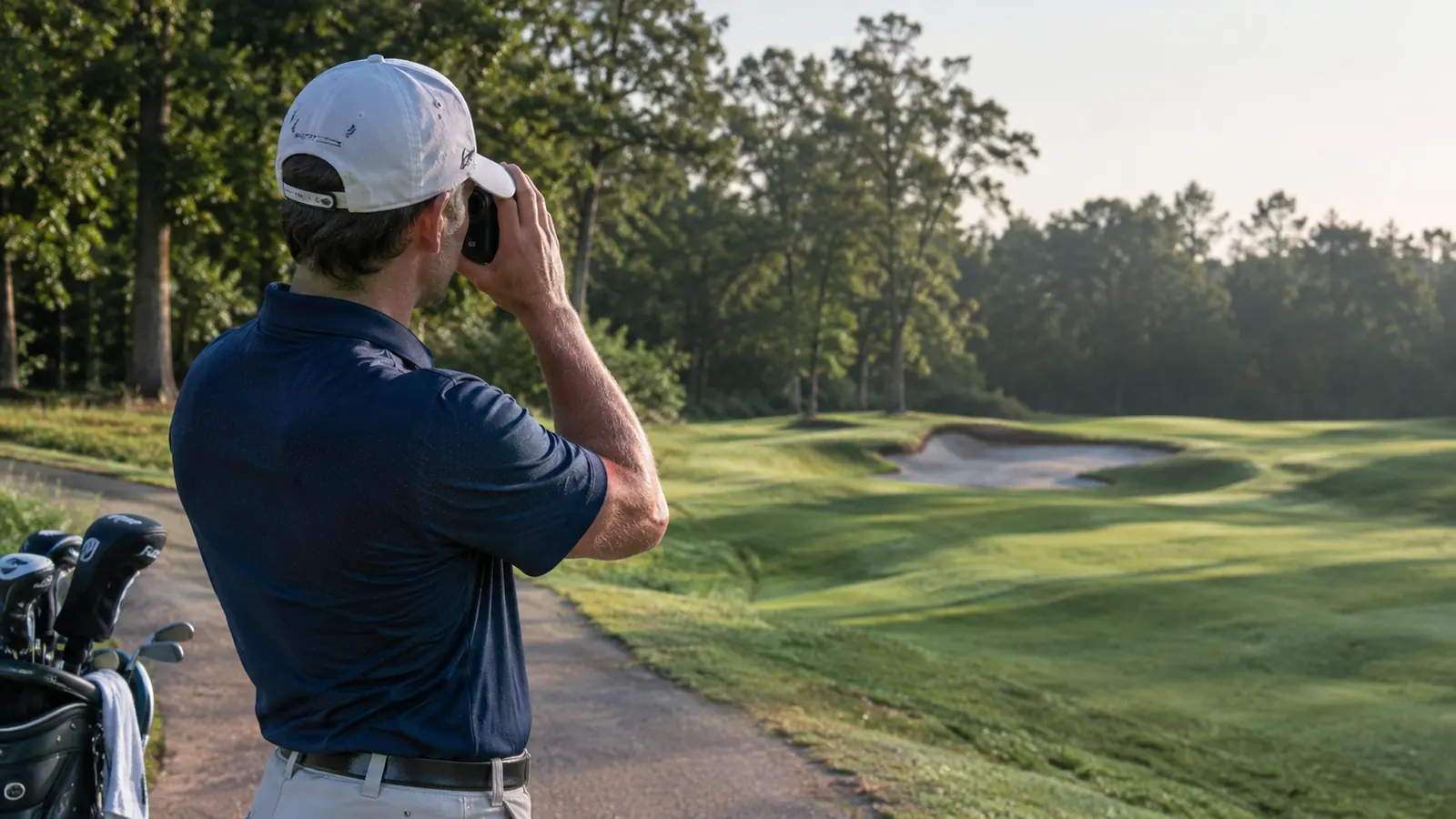
Approach shots are where the 300 Pro earns its keep. From 150 yards out, a difference of five yards is the difference between a makable birdie putt and a two-putt par. I used to pick clubs based on what I hit last week, not what the shot in front of me required.
Now I shoot the flag, then I shoot the front of the green, then I shoot the back. That gives me the full picture. If the flag is on the front edge and the green is shallow, I know I can miss long and still be okay. If the flag is tucked behind a bunker, I know to aim at the middle of the green and take my par. Here is a shot from a round in September. I was on the 16th fairway, 158 yards from the flag on a par 4. The flag was front left, just over a bunker, with the green running away from me. The straight number was 158. The slope number said 168 because the shot played slightly uphill. I hit my 6-iron, which is my 160 club, carried the bunker by about two yards, and stopped 12 feet from the pin. Two years ago I would have hit the same 6-iron at the middle of the green, come up short, and watched the ball roll back off the front edge. The rangefinder did not make the swing. It just gave me the one number that made the swing worth taking.
The Callaway 300 Pro locks onto the flag fast, and the vibration feedback is reliable even in bright sun. That matters when you are standing over a 7-iron with a creek on the left and a bunker on the right. The number in your hand is the one thing you can trust.
Step 5: Use It on the Green and Around It
The rangefinder is not just for full swings. I use it on the putting green to measure the distance to the hole on long lag putts. From 40 feet away, the difference between 35 and 45 feet changes how I read the break and how hard I hit it. Two weeks ago on the 9th green I had a 42-foot lag putt, uphill with a right-to-left break. I shot the flag, got 42, and hit the putt with a number instead of a guess. I left it 18 inches short, which is a two-putt I used to turn into a three-putt all the time.
Around the green, I use it to decide between a bump-and-run and a flop shot. If the flag is 20 feet on, I can take the lower-risk shot. If it is 5 feet on with a bunker behind, I know I have to carry it. It sounds like a small thing, but it removes the guesswork from the shots that decide most of my matches. Most of my Saturday matches come down to these little shots. Last month I had a pitch from 23 yards with the pin 8 feet on and a bunker right behind it. The rangefinder said 23, and the green was firm, so I knew the ball had to land before the hole and check. I hit a gap wedge that landed 6 feet past the fringe and stopped 4 feet from the cup. That is a par I used to turn into a bogey.
One honest note: I do not use it for every single putt. On short putts, the feel of the green matters more than the number. But for anything over 20 feet, I would rather know the distance than guess it.
What Else Helps
A rangefinder is only as good as the routine around it. I keep the Callaway 300 Pro in the same pouch on my push cart, in the same spot, every round. That means I never dig around for it when I need it. I also keep a small notebook and a pencil in the pouch, because a number you write down is a number you remember.
The other thing that helped me was practicing with the rangefinder on the driving range. The range near my house has flags at 50, 75, 100, 125, 150, and 175 yards. One afternoon last fall I shot each flag with the Callaway 300 Pro and then hit five balls at each one. What I learned was humbling. My 7-iron, which I had always called my 150 club, actually carries 142 and rolls out to about 148. My 9-iron carries 118, not 125. Those are the numbers I play with now. The whole session took about an hour and a half, and it changed every club selection I have made since. That is the fastest way I know to make a rangefinder pay for itself.
I did not trust the slope number, and it cost me the hole and the match.
Stop Guessing and Start Measuring
The Callaway 300 Pro is the rangefinder I carry every round. It is quick, it is accurate, and it fits the way a weekend golfer actually plays. Check today's price on Amazon and put it in your bag.
Amazon Check Today's Price on Amazon →