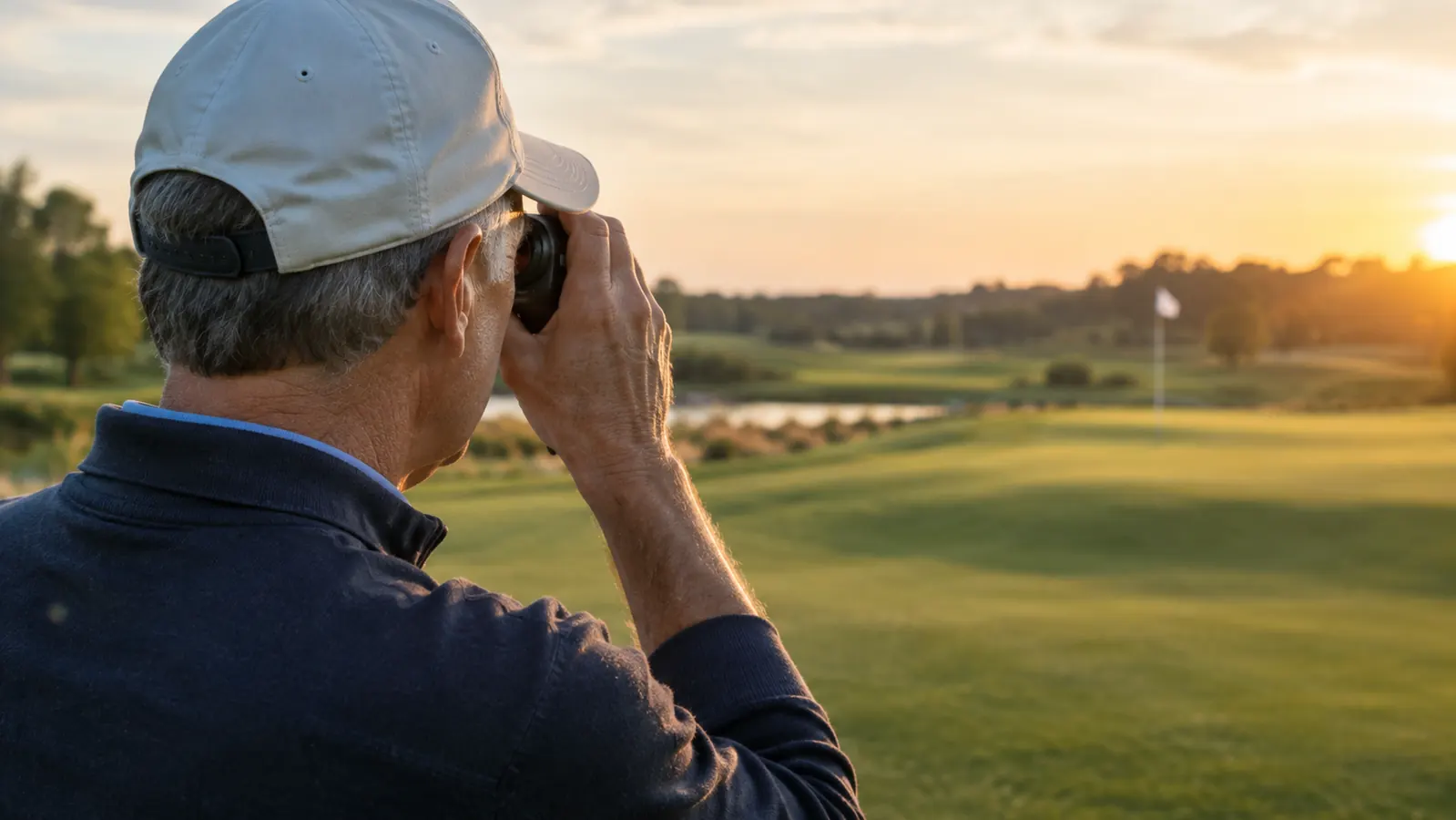
I bought the Callaway 300 Pro at the start of last season because my home course has a handful of blind tee shots and I was tired of guessing. I am 58, I play to about a 14 handicap, and I walk nine holes twice a week with the same three buddies. I am exactly the golfer this rangefinder is aimed at, which is why I want to be honest with you about what it does well and what it does not.
The short version: the Callaway 300 Pro is a solid, mid-priced laser rangefinder that gives you accurate yardages to the flag and a slope number when you want it. It is not the fanciest unit Callaway makes, and it is not the cheapest. It sits in the middle, and for most of us that is exactly where it belongs. But there are a few things the product page does not tell you, and those are the things I want to cover here.
The Quick Verdict
A dependable, no-drama rangefinder that does the two jobs most golfers actually need: accurate distance to the flag and a slope number you can switch off for competition. The optics are good, the build is solid, and the battery life is genuinely impressive. It is not the last word in rangefinder technology, but it is the one I reach for every round.
Amazon Check Today's Price →The rangefinder I actually carry every round
After a full season of walking nine and eighteen hole rounds, the Callaway 300 Pro is the one that stays in my bag. It locks onto the flag fast, gives me a slope number when I want it, and has never let me down in the rain. Check today's price on Amazon and see if it fits your game.
Amazon Check Today's Price on Amazon →What I Liked
- Accurate to the flag and slope readings I trust, checked against course markers and a friend's higher-end unit
- External slope switch makes tournament play simple
- Scan mode gives you a full picture of blind holes
- Battery lasts a full season on one CR2
- Rubber armor has survived drops and rain
Where It Falls Short
- Easy to bump the slope switch without noticing
- Vibration lock is weak through a glove on windy days
- No magnet, no rechargeable battery, black display only
- Manual is easy to skim past the diopter adjustment
How I've Used It
I have used the Callaway 300 Pro for about 30 rounds and maybe 15 range sessions. That includes early morning dew, a few rounds where it rained on me for six holes, and one Saturday in August where the heat index was over 100. I keep it clipped to the handle of my push cart, which means it bounces around for four hours at a time. It has never turned itself off unexpectedly, never fogged up, and never given me a reading I did not trust.
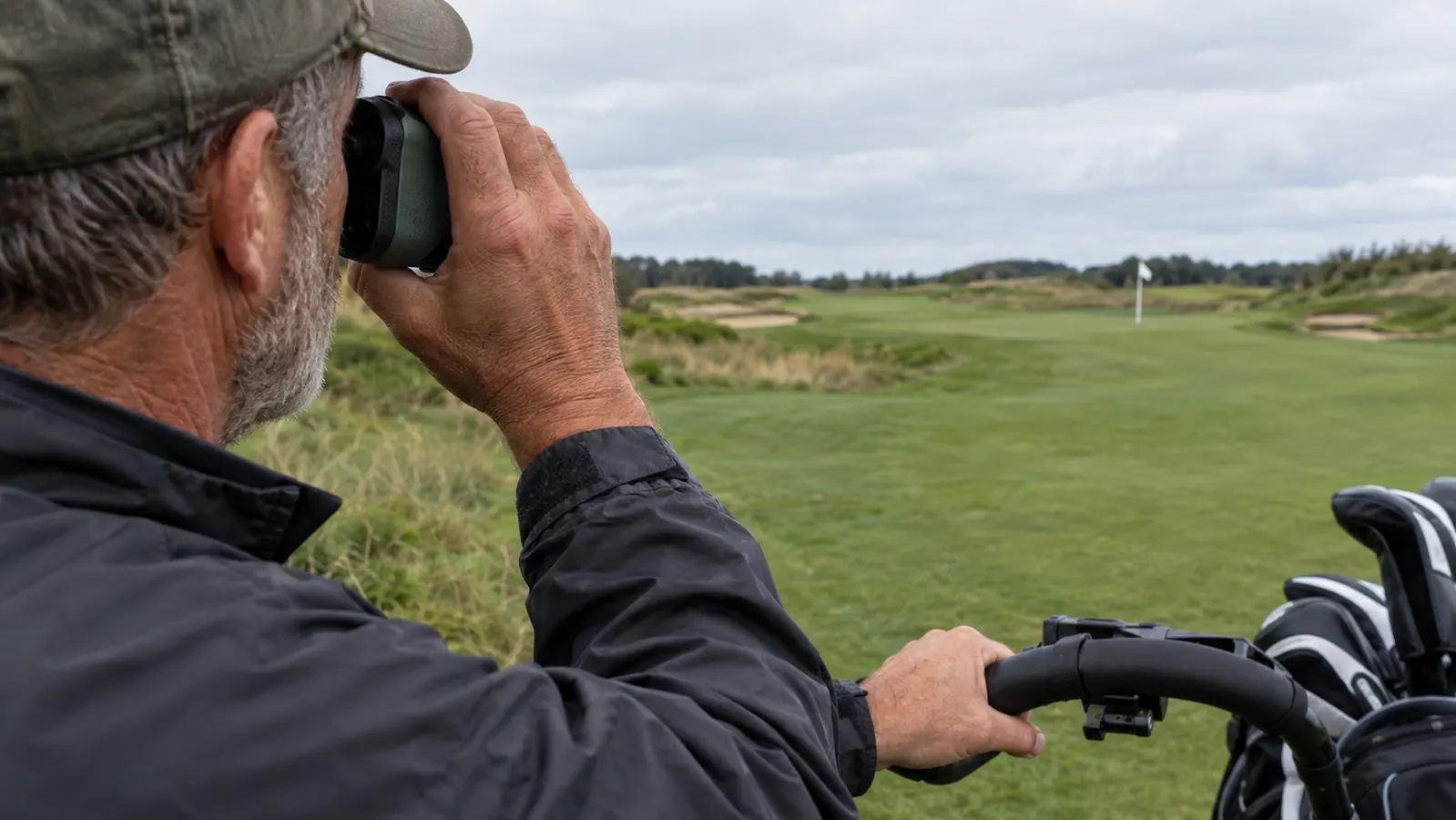
My routine is simple. On the tee, I shoot the flag, then the front of the green, then the back. That gives me a number I can play to even when I cannot see the bottom of the flagstick. On approach shots, I shoot the flag and let the slope number tell me whether to take one more club or one less. I do not use the slope feature in league play because the rules do not allow it, and the external switch makes that easy.
The thing that surprised me most is how often I use the scan mode. I did not think I would. But on blind tee shots, sweeping the tree line and letting the numbers roll gives me a much better picture of the hole than I ever got with a GPS watch. The Callaway 300 Pro does not just give you one number. It gives you a whole set of them, and that changes how you play a hole you cannot see.
One round that stands out was a windy Tuesday in May. The pin was tucked behind a bunker on the seventh hole, and the flag was hard to see against the trees. I used the scan mode to get the front and back of the green, then let the slope number tell me the green was playing slightly downhill. I hit the shot and watched it stop ten feet from the pin. That is the kind of round that makes the Callaway 300 Pro worth the money, not because it hits the shot for you, but because it takes the guesswork out of the decision.
What Nobody Tells You Before You Buy
Here is the honest part. The Callaway 300 Pro is a good rangefinder, but it has quirks, and you should know about them before you spend your money.
First, the slope switch is on the outside of the unit, which is great for tournament players who need to turn it off and on. But it is also easy to bump. I have reached into my bag more than once and found the switch flipped to slope when I thought it was off. One Saturday before a league match, I checked the switch on the first tee and it had moved during the ride to the course. It is not a dealbreaker, but it means you should check the switch before a round that matters.
Second, the eyepiece has a diopter adjustment, and you need to set it for your eye. I skipped this for the first two weeks and wondered why the display looked slightly soft. Once I turned the ring until the numbers snapped into focus, everything got clearer. The manual mentions it, but it is easy to miss, and it makes a real difference for golfers over 40. I wear reading glasses for close work, and without the adjustment I found myself squinting at the display on bright days. After I set it, I could read the yardage without lifting my glasses.
Third, the vibration lock is a small buzz, not a strong pulse. On a windy day, you might not feel it through a gloved hand. I have learned to watch for the red ring around the flag instead. That red ring is the real confirmation, and once you know to look for it, you will not miss a reading. The first time I used it in a gust, I thought the unit had failed because I felt nothing, but the red ring was there the whole time. Now I trust the ring and treat the buzz as a bonus.
The last thing nobody tells you is that the 300 Pro rewards a steady hand. If you try to shoot the flag while you are still moving, you will get a reading off the trees behind the green. I learned to brace my elbow against my chest and pause for a second. Once I did that, my readings stopped jumping around. That is a technique thing, not a flaw in the unit, but it took me a few rounds to figure out.
The Callaway 300 Pro has never given me a yardage I did not trust, and after 30 rounds, that is the only thing that really matters.
Accuracy and Performance on the Course
I checked the Callaway 300 Pro against the marked yardages on my home course and against a friend's higher-end rangefinder on a few holes. The numbers matched within a yard every time. On the par 5 fourth hole, the marker at the 150 stake read 149 when I shot the flag, and my friend's unit read 150. That is the whole job, and it does it. The JOLT technology, which is Callaway's name for the vibration you feel when you lock onto the flag, works well once you learn to read it.
The slope feature is where this rangefinder earns its keep for me. My home course has a par 3 that plays 152 yards uphill, and I used to come up short constantly. With the slope number, I know it is playing 160, and I take one extra club. That one hole alone has saved me more strokes than I can count. I have also used it on a downhill par 4 where the slope reading told me to take one less club, and I landed on the front edge instead of flying the green. If you play a course with any elevation change at all, the slope feature is worth having.
The optics are clear and bright, even in low light. I have used it at dusk when the sun was going down behind the trees, and I could still see the flag and get a reading. The magnification is 6x, which is plenty for seeing a flagstick from 200 yards out. I have never wished for more magnification, and I have never had trouble picking the flag out of a cluttered background. On one hole with a pond and a bunker behind the green, the flag was easy to isolate because the red ring showed me exactly what the laser was locked on.
Speed matters more than I expected. The 300 Pro gives me a reading in about two seconds once I am steady. That does not sound like much, but when you are playing with three other guys waiting on the tee, it keeps the pace of play moving. My buddy's older rangefinder takes twice as long to settle, and you can feel the group get impatient. The fast lock is one of the reasons I keep reaching for this one.
Battery Life and Build Quality
The Callaway 300 Pro uses a CR2 battery, and I have changed it exactly once in a full season. That is the honest number. I expected to be swapping batteries every few weeks based on some reviews I read, but the unit seems to power down quickly when you set it down, and the battery meter on the display is accurate. When it finally did get low, the display warned me clearly, and I had plenty of time to grab a new one. The low battery warning appeared during a Wednesday nine-hole round, and I finished the round without losing a reading. I changed it that evening and have not thought about it since.
The body is rubber-armored and feels solid in the hand. I have dropped it on the cart path once, and it survived without a scratch. That drop happened on the fourth hole of an eighteen-hole Saturday round, and the unit kept working perfectly for the remaining fourteen holes. The lens cap snaps on and off easily, and the carrying case is basic but fine. The strap is a little thin for my taste, but it has not broken, and I have not felt the need to replace it.
One thing I will say about the rain: the Callaway 300 Pro is water resistant, not waterproof. I have used it in light rain without any trouble, but I would not leave it out in a downpour. One Tuesday last fall, it started raining on the fifth hole and did not stop until we finished. I kept the unit clipped to my push cart under the towel, and it never fogged or skipped a reading. If you play in heavy rain often, you will want to keep it in your bag or under a towel between shots. That is true of most rangefinders in this price range, so it is not a mark against this one specifically.
The clip on the included case is the weak point, honestly. It is fine for clipping to a bag loop, but I clip the whole case to the handle of my push cart, and the plastic latch has gotten a little loose over the season. The rangefinder has never fallen out, but I now clip the case so the latch sits on top. It is a small thing, and I would not trade the unit over it, but it is the kind of detail the reviews do not mention.

Who This Is For
The Callaway 300 Pro is for the golfer who wants accurate yardages without paying for features they will never use. If you are a weekend player, a league golfer, or someone who walks nine holes after work, this is the rangefinder for you. It gives you the two numbers that matter, distance and slope, in a package that is easy to use and easy to trust.
It is also a great choice if you play in tournaments or league matches where slope is not allowed. The external switch means you can turn it off in two seconds, and the unit looks the same either way. You do not have to buy a separate tournament-only rangefinder, and you do not have to worry about a playing partner questioning whether your device is legal.
Who Should Skip It
If you want a rangefinder with a red display, a rechargeable battery, or a magnet that sticks to the cart, the Callaway 300 Pro is not it. Those features exist on other models, and if they matter to you, you should look elsewhere. The display here is black, the battery is a standard CR2, and there is no magnet. None of those things bothered me, but they are worth knowing before you buy.
I would also say this: if you only play a handful of times a year and you are happy with the yardage markers on the course, you do not need a rangefinder at all. The Callaway 300 Pro will not lower your score by itself. It will give you better information, and better information leads to better club choices, but you still have to hit the shot. I have watched my buddies buy rangefinders and then three-putt just like always.
The Bottom Line
The Callaway 300 Pro is the rangefinder I recommend to anyone who asks, and it is the one I carry every round. It is accurate, durable, and simple to use, and it has held up to a full season of being clipped to a push cart and bounced around a public course. It is not the cheapest rangefinder you can buy, and it is not the most advanced, but it is the one that does the job without getting in the way.
If you are an everyday golfer who wants to know exactly how far you are from the flag, the Callaway 300 Pro is a smart buy. Check today's price on Amazon, read the reviews, and decide for yourself. I think you will be glad you did.
Ready to stop guessing your yardages?
The Callaway 300 Pro has been in my bag for a full season, and it has never let me down. It locks onto the flag fast, the slope switch is easy to flip for league play, and the battery lasts all year. See today's price on Amazon and get the same numbers I trust every round.
Amazon Check Today's Price on Amazon →