
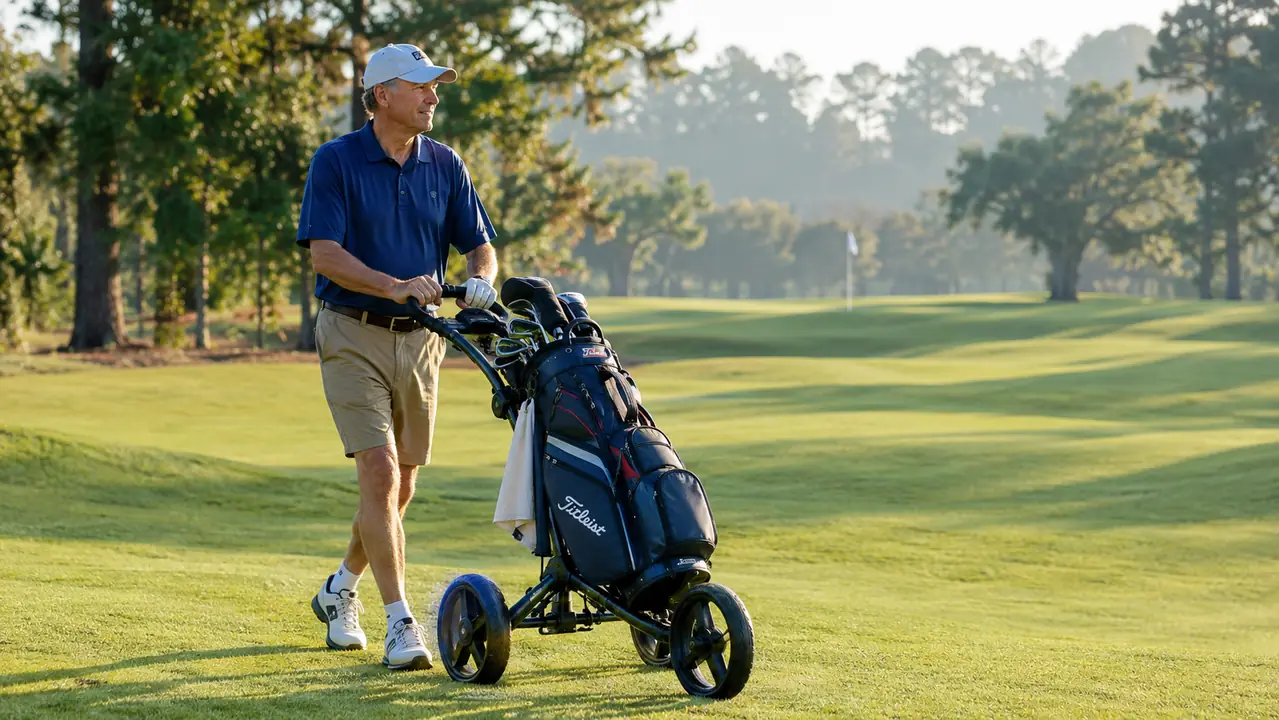
I turned 58 last spring, and my back let me know before the first tee did. For years I carried my bag on my shoulder for nine holes, sometimes eighteen, and told myself the extra weight was good for me. It was not. A Saturday round in May left me bent over the kitchen counter for two hours, and my wife Carol said what I already knew. Something had to change. I spent the next week reading about push carts, measuring my trunk, and asking everyone at the course what they used.
I settled on the Caddytek CaddyLite 11.5 V3, and it changed how I feel after a full round without changing my swing at all. I play to about a 14 handicap. I walk nine holes twice a week at my local public course here in Monmouth County, New Jersey, and a full eighteen on Saturday with the same three buddies. This article is the exact routine I use, step by step, from the parking lot to the last putt. If you are over 40, carry your bag, and have ever spent Sunday morning with a heating pad, this is for you.
Walk 18 holes and still bend over to pick your ball up on 18.
The Caddytek CaddyLite 11.5 V3 is the cart I use every round now. Light enough to lift into the trunk, folds flat, and it takes the weight off your back before it ever reaches it.
Amazon Check Today's Price on Amazon →Step 1: Set the Cart Up Once, Properly, in Your Garage
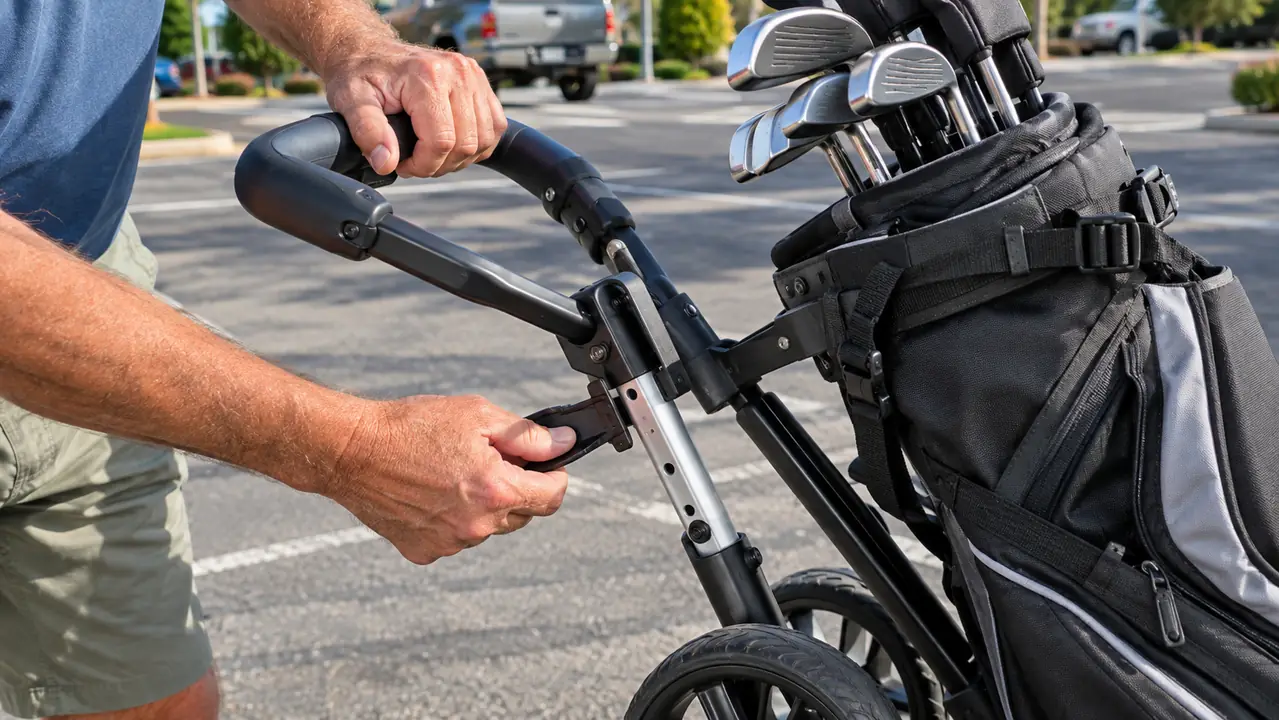
The Caddytek CaddyLite 11.5 V3 folds flat and unfolds in a few seconds, but the first time you do it should not be in a crowded parking lot ten minutes before your tee time. Bring it home, put it on the garage floor, and unfold it until all three wheels lock into place. The frame is lightweight aluminum, so this is not a wrestling match. Find the lever that adjusts the handle height and set it so the handle sits about waist high when you stand tall. You should never have to reach down or hunch forward to grip it.
Then fit your bag the way you will use it for the whole season. Position the bag on the bag rest so the clubs face forward as you walk, with the heaviest part of the bag low and close to the wheels. The cart has straps to hold the bag in place. Tighten them until the bag does not shift when you rock the cart side to side. This sounds like a small thing, but a bag that sits wrong makes the whole cart pull to one side and puts a twist in your back that you will feel by hole 12. Take the extra minute to get it square.
Do this once and you are done for the year. The same setting works every round after that. I keep the cart unfolded in the garage with the bag on it, so Saturday morning is just a matter of rolling it to the car and folding it into the trunk. Ten minutes of setup at home saves a rushed, sloppy setup at the course, and it means the first time I touch the cart on game day is already the hundredth time I have handled it. If you are the first one at the course on a cold morning, you will be glad you practiced in the warm garage.
Step 2: Build a Routine for the Parking Lot
When you get to the course, do the same three things in the same order every time. Pull the cart out of the trunk, unfold it until all three wheels click into place, and set the brake. Then set the bag on and strap it down exactly the way you did in the garage. Then walk the cart around the back of your car once to make sure nothing rattles and the bag is square. It takes about ninety seconds, and it is the same ninety seconds every Saturday.
A routine matters more than you think. When I carried, I would sling the bag on my shoulder and walk to the first tee already a little off balance. With the cart, I take the same route every week: out of the lot, past the practice green, up the cart path to the first tee. I keep my shoulders level and my hands light on the handle. By the time I hit my first drive, my back feels the same as when I left the house, which is exactly the point. It sounds too simple to matter, but I notice the difference on the days I skip the routine and just grab the cart by the handle.
One note about the brake. The Caddytek has a wheel brake that holds the cart in place on a slope. Use it any time you stop on uneven ground, even for a moment. A cart that rolls into your leg while you are lining up a putt is a small annoyance, but a cart that rolls away down a slope while you are on the green is a long walk and a bad start to the back nine.
Step 3: Push With Your Whole Body, Not Just Your Arms
The biggest mistake I see with push carts is people leaning on them like a walker. You should not be resting your weight on the handle. You should be standing tall, arms relaxed, and pushing the cart with a slight forward lean from your core. Think of the push coming from your legs and hips, not from your shoulders. If your shoulders are up by your ears by the third hole, you are doing it wrong, and your neck will tell you before the turn. One of my buddies put it best: if your hands are white on the handle, you are pushing too hard.
This is where the lightweight aluminum frame of the Caddytek helps. The cart rolls ahead of you with very little effort, so you can keep your posture instead of muscling it. I keep my elbows bent at about ninety degrees and my wrists neutral. On flat ground, a light steady push is enough. On an uphill, I shorten my stride and let the cart roll at the same speed I am walking. I do not pull it, and I do not let it get so far ahead that I have to stretch for the handle.
On downhills, use the brake. I use it more than I expected. Walking downhill with a cart rolling ahead of you is a great way to turn a good round into a sore lower back, because you end up reaching forward the whole way down. Set the brake enough to slow the cart, keep your body over your feet, and take your normal stride. The cart should feel like a quiet partner, not a dog on a leash that keeps pulling.
Step 4: Use the Cart to Keep Your Energy for the Swing
The reason I walk is the rhythm of the round. A cart lets you keep that rhythm without the fatigue of carrying. But you still have to manage your pace. I walk at a steady speed between shots, not a sprint. When I carried, I would rush to my ball, catch my breath, and then try to hit. With the cart, I get to my ball, take two slow breaths, and set up. That alone makes my swing feel smoother on the back nine, and it makes the whole round more fun.
I also use the cart as a small caddy. I keep a water bottle in the storage area, a couple of snacks in the pocket, and a light rain jacket in the bottom of the bag. If the pace of play slows, I drink water and eat something small. A push cart will not keep you fresh if you forget to eat and drink. It just makes it easier to carry what you need, so bring what you actually want.
The other thing the cart does for me is keep me honest about my back. Halfway through a Saturday round, I check in with myself: shoulders level, hands light, breathing steady. If I feel tight, I roll my shoulders once and slow down. I would rather finish the round a little slower and still be able to bend over to pick up my ball on 18. That is the whole reason I stopped carrying. I have played rounds where I rode and rounds where I walked, and the walking rounds are the ones I remember. The score is usually the same. The walk is the part that stays with you.
Step 5: Take Care of the Cart So It Lasts
After the round, I do not just throw the Caddytek back in the trunk. I wipe the wheels and frame with an old towel, especially if the course is wet or dewy. Sand and mud build up in the wheel hubs and the folding joints, and that is what makes a cart get stiff over time. A minute with a towel at the car keeps the folding mechanism smooth for years. It also keeps the trunk from smelling like a wet mop.
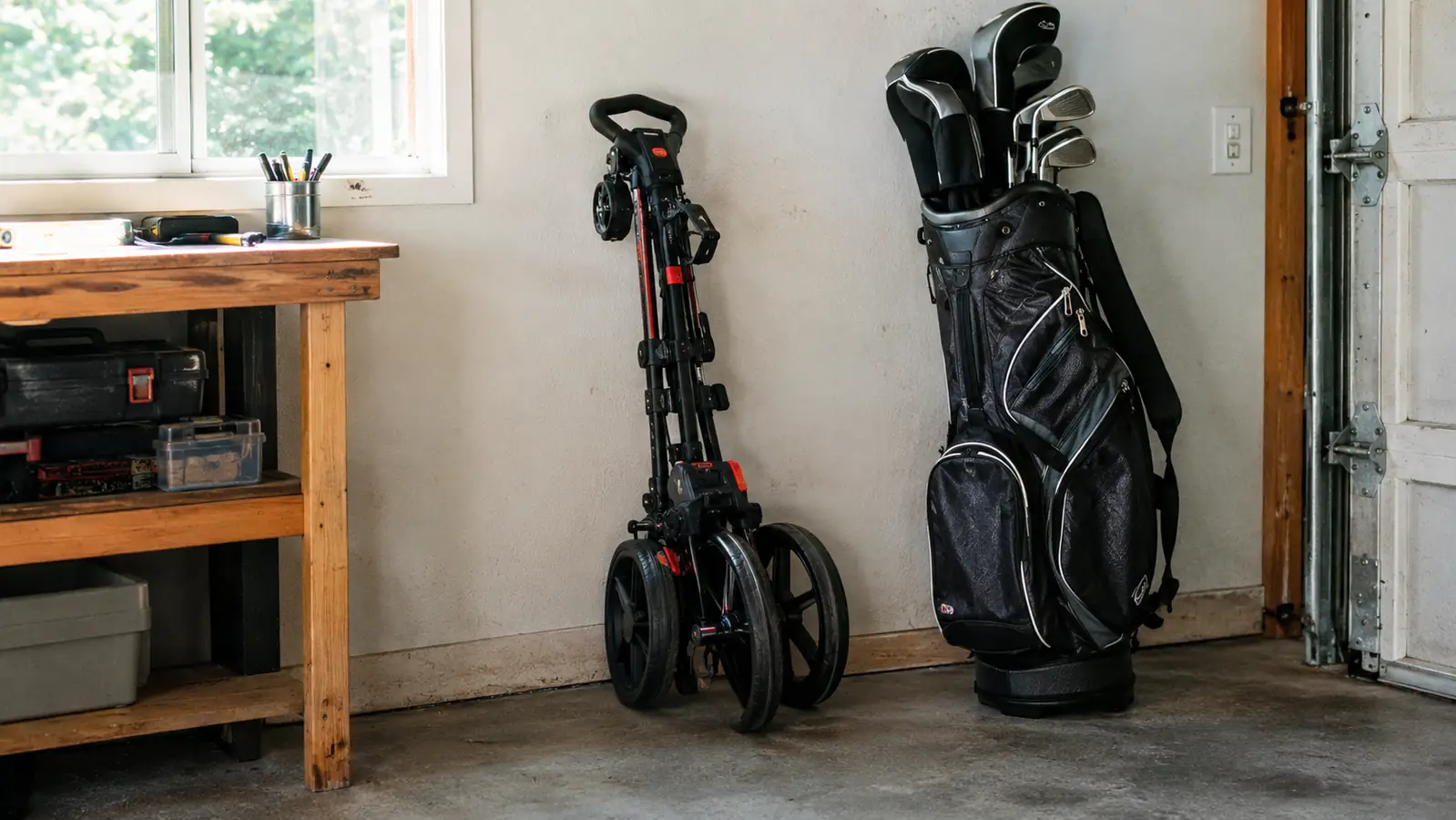
At home, I fold the cart flat and lean it against the garage wall with the bag still on it. That is where my yellow Lab Murphy likes to sniff it and occasionally lean against it, and it has held up fine. The frame is aluminum, so it does not rust the way an older steel cart would. I check the straps twice a year and test the wheel brake before the first round of the season. That is the whole maintenance list, and it takes five minutes.
Folding the cart takes about fifteen seconds, and unfolding is the same. If you store it with the bag on, make sure the bag is dry first, because a damp bag in the garage is how you end up with a musty smell in the trunk. Keep it simple, keep it dry, and the cart will outlast your good shoes and probably your current driver. You do not need to take anything apart. A damp towel and a dry place to store it are the whole system.
What Else Helps
Walking with the Caddytek cart solved the carrying problem, but it is only half the story. A few other habits keep my back happy through a full eighteen. None of them cost money, and none of them take more than a few minutes.
Shoes matter more than any cart. I wear spikeless walking shoes with real support, not the same pair I wore for five seasons. If you are walking eighteen, your shoes are the suspension between your back and the ground. Replace them when the cushioning is gone, which is usually long before the tread wears out. Your feet will thank you, and so will your lower back.
I also stretch for five minutes before I leave the house, not on the first tee. Hamstrings, hips, and lower back. Ten forward folds, ten slow squats, and a doorway chest stretch. It is boring, and it works. One of my buddies still rides in a cart and teases me about it. He is also the one who sits in the parking lot after the round before he can get out of the cart.
One more thing: take the handle height seriously. The Caddytek handle adjusts, and I have mine set to waist height. A handle set too low makes you hunch. A handle set too high makes you reach. Five minutes of adjustment in the garage is worth more than any swing tip I have read in the last ten years, and it costs nothing.
Since I switched to the Caddytek, I finish Saturday rounds standing straight, and I am not the one reaching for ibuprofen on the drive home.
Give your back the break it gave mine.
If you walk nine or eighteen holes, the Caddytek CaddyLite 11.5 V3 takes the load off your spine before it ever gets there. Fold it, load it, and push it. That is the whole job.
Amazon Check Today's Price on Amazon →