

I have walked a lot of fairways with a bag on my shoulder, and my left shoulder has the scar tissue to prove it. At 58, with a 14 handicap and a standing Saturday game with the same three buddies, I finally admitted that carrying was the problem, not the exercise. So I spent last season pushing a Caddytek CaddyLite 11.5 V3 around my home course, and I want to tell you the things the product page does not.
The Caddytek CaddyLite 11.5 V3 is one of the most popular push carts on Amazon, with over 4,200 ratings and a 4.6 average. That sounds like a slam dunk. But popularity and suitability are not the same thing, and after nine months of twice-weekly nine-hole walks plus a Saturday 18, I have a pretty clear picture of who should buy this cart and who should keep looking.
The Quick Verdict
The Caddytek CaddyLite 11.5 V3 is the best value push cart I have used, provided you are an average-sized golfer who walks on mostly flat ground and does not need a cart that folds into a carry-on bag.
Amazon Check Today's Price →The push cart that got my bag off my shoulder for good
After 27 holes a week for a full season, the Caddytek CaddyLite 11.5 V3 is the cart I reach for. It is light, it rolls well, and it costs a fraction of what the big-name carts run.
Amazon Check Today's Price on Amazon →How I've Used It
Before I bought the Caddytek CaddyLite 11.5 V3, I carried my bag for two seasons, then I dragged a two-wheel pull cart from the 1990s that my father-in-law gave me. That thing weighed close to thirty pounds on its own, and by the 14th hole I was leaning forward like a man walking into wind. The last straw was a Tuesday morning in late March. I got home from a nine-hole walk, and Carol asked why I was walking bent over. That was the day I started reading push cart reviews.
I ordered the Caddytek in early April and used it for the entire season. That means two nine-hole walks a week at my home course, a Saturday 18 with my regular foursome, and a handful of range sessions where I pushed it from the parking lot to the grass. My bag is a standard stand bag, not a lightweight carry bag, and it rides fine. The strap system holds it tight enough that nothing shifts on the first hole, which was my worry.
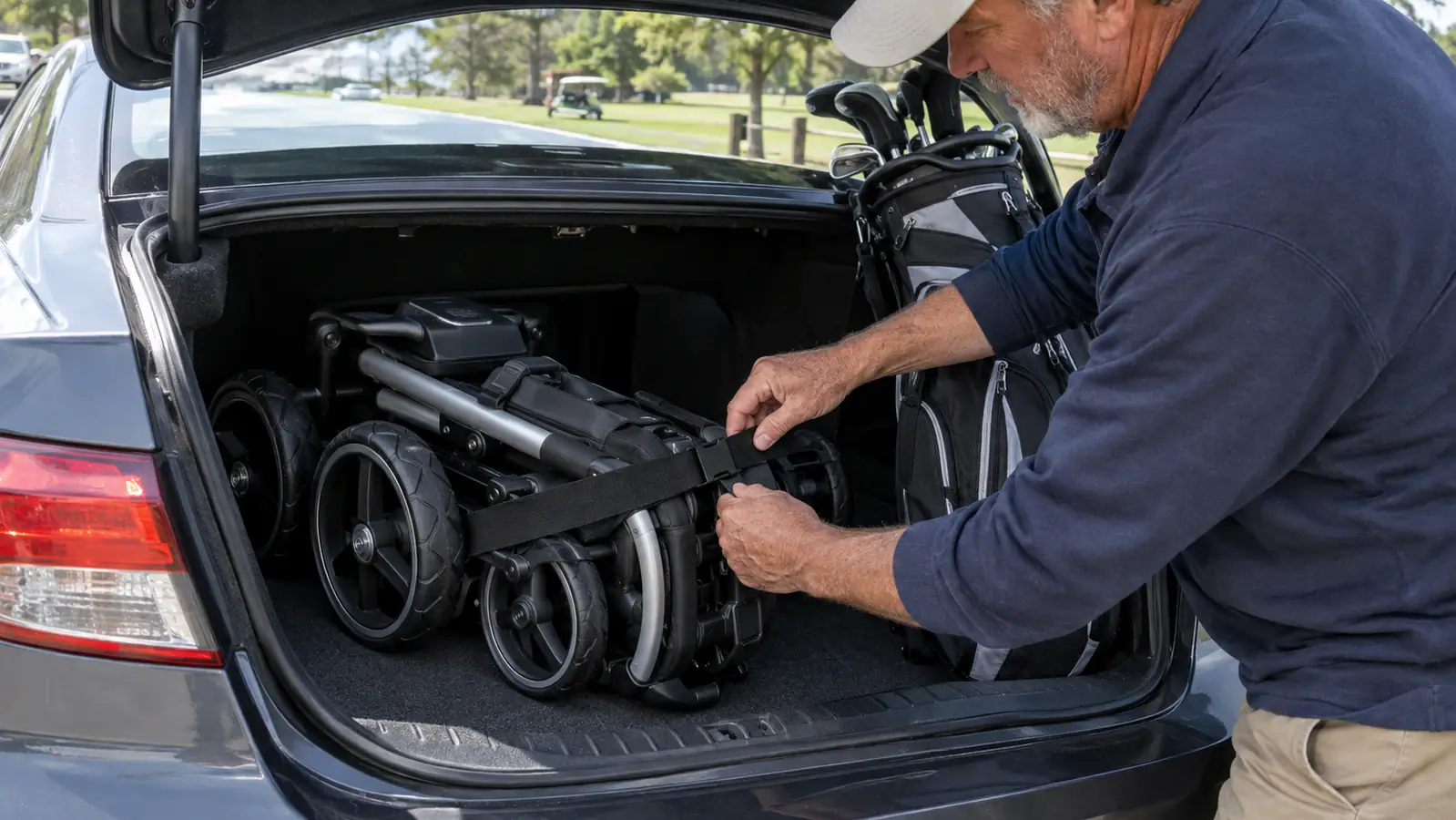
The cart weighs about 16 pounds, which matters more than you think. My old pull cart weighed nearly twice that, and the difference in my lower back by the 14th hole is the whole reason I switched. I can lift the folded Caddytek into the trunk of my sedan with one hand, no grunt, which is not something I could say about the old cart. It also means the cart fits in the trunk with room for my bag and Carol's grocery run on the way home.
Assembly took me about 20 minutes with a hex key that is included. The instructions are mostly pictures, and a couple of the steps are easy to get backwards. I put the front wheel bracket on upside down the first time and had to take it apart and start over. Nothing about it is hard. If you have put together a grill or a kids' bike, you can handle this.
The first round with the Caddytek was a nine-hole walk on a Thursday afternoon in mid-April. I was slower than my usual pace because I kept stopping to check the straps and the brake, but by the third hole I stopped thinking about the cart entirely. That is the real test of a push cart: you forget it is there. By the end of that round my shoulder felt the way it used to after a light practice session, not after nine holes of carrying.
What Nobody Tells You About the Wheels and Brake
The front wheel swivels, which sounds great until you are on a sidehill and the wheel wants to turn downhill every time you set the cart down. My course has a par 5, hole 6, that slopes left to right for about 200 yards. The first time I played it with the Caddytek, I set the cart down on the slope to take a practice swing, and the front wheel turned itself downhill, which pulled the whole cart off balance and it started rolling toward the rough. I caught it before it got far, but it was a lesson. There is a lock lever on the front wheel, and I use it more than I expected. Once I started using it on any hole with even a hint of slope, that stopped happening. On flat holes I leave it unlocked and the cart tracks beautifully. The lock lever clicks when it engages, so you can confirm it without bending down to look. That is a small thing, but nobody mentions it in the reviews.
The brake is a foot pedal on the left rear wheel, and it works. It clicks into place with a solid sound, and it holds. I tested it on the hill behind the 8th green at my course, which is steep enough that I would not leave a bag leaning against a tree on it. I set the cart with the bag loaded, pushed the pedal down, and gave the cart a nudge with my foot. It did not move. I also learned the hard way to set the brake before I take my hand off the cart. On a windy day in May, I let go of the handle to pick up a ball marker, and the cart started rolling on a downhill stretch of cart path. It did not tip, but it rolled about twenty feet before I caught it. Now the brake goes on every time I stop. What nobody tells you is that the brake pedal is on the left side, and if you are used to a different cart, you will kick at nothing for the first few rounds. It took me about three rounds to stop looking for the brake on the right.
The brake holds on a slope, the front wheel locks for sidehills, and the whole thing weighs 16 pounds. What more do you actually need from a push cart?
The Storage and Accessories Reality
The Caddytek has a small storage pouch under the handle and a mesh pocket on the side. The pouch is big enough for a phone, a wallet, and a pack of tees. It is not big enough for a rain jacket, and the mesh pocket is not waterproof. I learned that the hard way one Tuesday in June when a sudden shower soaked my glove, my scorecard, and half a sleeve of balls before I could get the cart under a tree. The scorecard dried well enough to keep, but the glove was done. If you play in wet weather, bring a dry bag or keep your valuables in your pocket.
The cart comes with a cup holder and an umbrella holder. The cup holder is a simple plastic ring that fits a standard water bottle or a small coffee cup. My insulated tumbler is too wide for it, so that cup rides in the mesh pocket, which means it is not held snug. The umbrella holder is a tube that mounts on the handle, and it works, but it puts the umbrella right in your line of sight if you are tall. I am 5'11" and I found myself ducking around it. My buddy who is 6'2" took the umbrella holder off after one round.
How It Handles on the Course
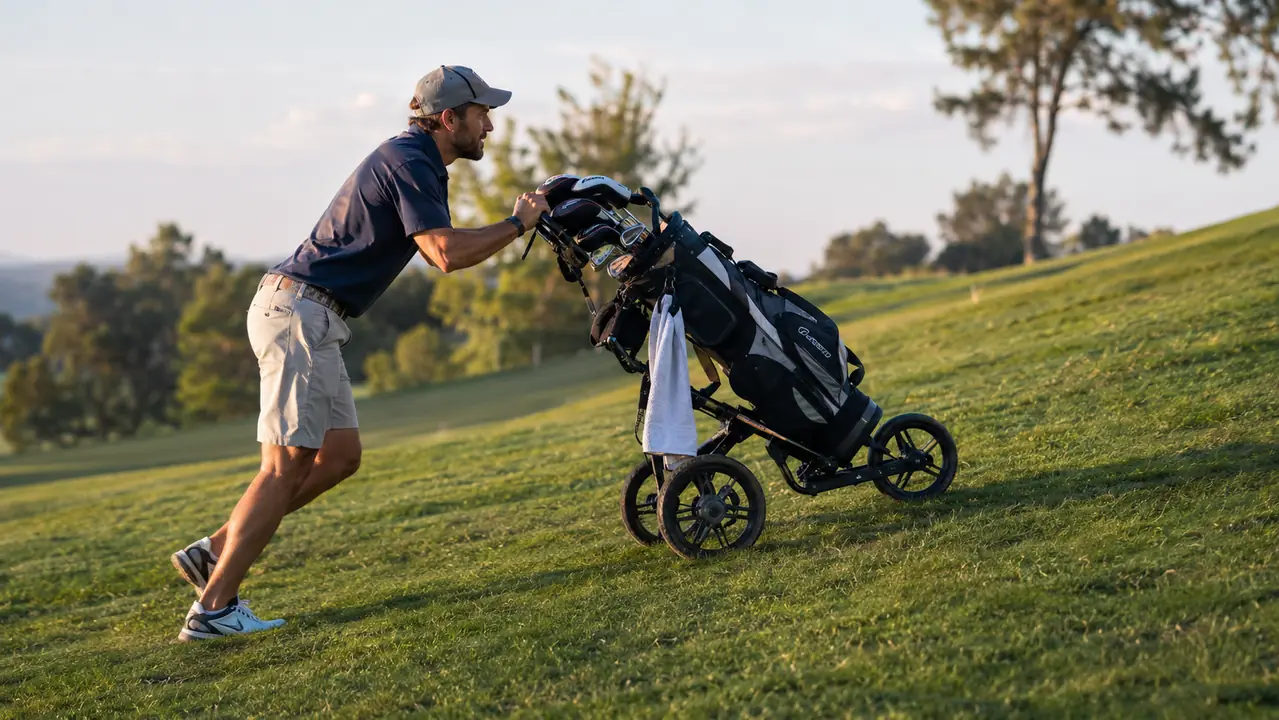
On flat fairways, the Caddytek CaddyLite 11.5 V3 is a pleasure. The wheels are large enough that they do not bog down in wet grass, and the cart rolls straight with one hand on the handle. I have pushed it with a coffee in the other hand, which is the real test of a push cart. On the cart path between 7 and 8, which is a long uphill stretch, the cart tracked straight with one hand while I carried a rangefinder in the other. The morning after a heavy rain in May, the course was still soaked and the rough was holding water. The cart pushed through it without fighting me. My buddy's cart, a cheaper two-wheel model, dug in and wanted to veer. That was the round I stopped second-guessing the purchase.
On hills, it is a different story. The cart is light, which is great for lifting it in and out of the trunk, but light also means it wants to tip if you push it up a steep slope with the bag loaded heavy. I have had the cart tip backwards twice on the hill up to the 12th tee. The first time, the bag slid down and the whole cart went over onto its handle. Nothing broke, but I had to walk back down to collect the balls that rolled out of the side pocket. The fix is to keep the bag strapped low and to tilt the cart back onto its rear wheels when you are climbing. Once I figured that out, the tipping stopped. I also learned to walk a slightly diagonal line on the steepest part of that hill, which is something you figure out for yourself and no manual will tell you.
The handle height adjusts, and I set it to the highest setting. My buddy who is 6'2" uses the second-highest setting. The adjustment is a simple push-button mechanism, and it has never slipped on me, even when I lean on the handle going up a hill. I will say this: the push button is stiff when the handle is new. For the first two weeks I needed both hands to change the height. After a month of use, it loosened up and now it moves with one hand.
The Folding and Storage Tradeoff
The Caddytek folds in three pieces: the handle folds down, the rear wheels fold in, and the front wheel folds under. The whole thing takes about 15 seconds once you know the sequence. The sequence is not obvious at first. The handle has a release collar that you pull up, not down, and the rear wheels have a latch on each side that you have to flip in the right order or the wheels bind. The first few times I folded it in the parking lot I felt like I was solving a puzzle. By the third round, it was muscle memory. My advice is to fold it twice in your living room the night it arrives, not on a cold morning in the parking lot with your foursome waiting. The folded cart is a little awkward to carry by the handle because the weight shifts, but it is light enough that you can grab it under one arm.
When folded, the cart stands on its own, which is nice in the garage. It is about 30 inches long and maybe 15 inches wide, and the folded height is roughly 13 inches, so it fits in the trunk of my sedan with the golf bag lying on top of it. I measured it because I was not sure. The bag sits fine on top of the folded cart, and nothing shifts on the drive to the course. It does not fit in the trunk of a small coupe with the bag, so if you drive something tiny, measure your trunk before you buy. A tape measure costs less than the return shipping on a cart that does not fit.
What I'd Change
If I could change one thing about the Caddytek CaddyLite 11.5 V3, it would be the storage. The pouch is too small, the mesh pocket is not waterproof, and there is no place to put a rangefinder where it will not bounce around. I keep my rangefinder in the pocket of my bag, which works, but it is not ideal. I have thought about adding a small handlebar bag, but the handle is already busy with the brake release and the umbrella holder.
I would also make the front wheel lock easier to reach. It is a small lever at the top of the front wheel assembly, and you have to bend down to flip it. On a course with a lot of sidehills, you are bending down every other hole, and that gets old by the back nine. It is a minor complaint, and I would still buy the cart again, but it is worth knowing before you commit.
What I Liked
- Weighs about 16 pounds, easy to lift in and out of the trunk
- Folds flat in about 15 seconds and stands on its own
- Front wheel lock handles sidehills well
- Foot brake holds firmly on slopes
- Price is well below the premium carts from bigger brands
- Smooth rolling on fairways and wet grass
Where It Falls Short
- Storage pouch is small and the mesh pocket is not waterproof
- Cart can tip on steep hills if the bag is loaded heavy
- Umbrella holder sits in the line of sight for taller golfers
- Front wheel lock requires bending down to reach
- Folding sequence takes a few rounds to learn
Who This Is For
The Caddytek CaddyLite 11.5 V3 is for the everyday golfer who walks most of their rounds, wants to save their back and their shoulders, and does not want to spend premium-cart money. If you are a weekend golfer in your 40s, 50s, or 60s, and you play a public course with some hills but nothing extreme, this cart will do everything you need. It is also a great choice for a first push cart, because the price means you are not making a huge commitment.
Who Should Skip It
Skip the Caddytek CaddyLite 11.5 V3 if you play a course with severe hills and you like to load your bag with everything including the kitchen sink. The cart is light, and light carts tip. If you are over 6'2", the handle height might be fine, but the umbrella holder will annoy you. And if you need a cart that folds small enough to fit in a compact car trunk with your bag, measure first. The Caddytek is not the smallest folding cart on the market. If your course is mostly cart-path-only with long climbs, a heavier cart with bigger wheels is the more honest answer.
Still the cart I grab every Saturday morning
After a full season, the Caddytek CaddyLite 11.5 V3 is still in my trunk. It is not perfect, but it is the best value in push carts I have found, and it got my bag off my shoulder for good.
Amazon Check Today's Price on Amazon →